Objects and inscriptions
The Great Isaiah Scroll (1QIsaᵃ) and the Dead Sea Scrolls
A near-complete scroll of Isaiah from Qumran Cave 1 is dated to the second century BCE. Its text is close to the later Masoretic Bible, but it is not identical.
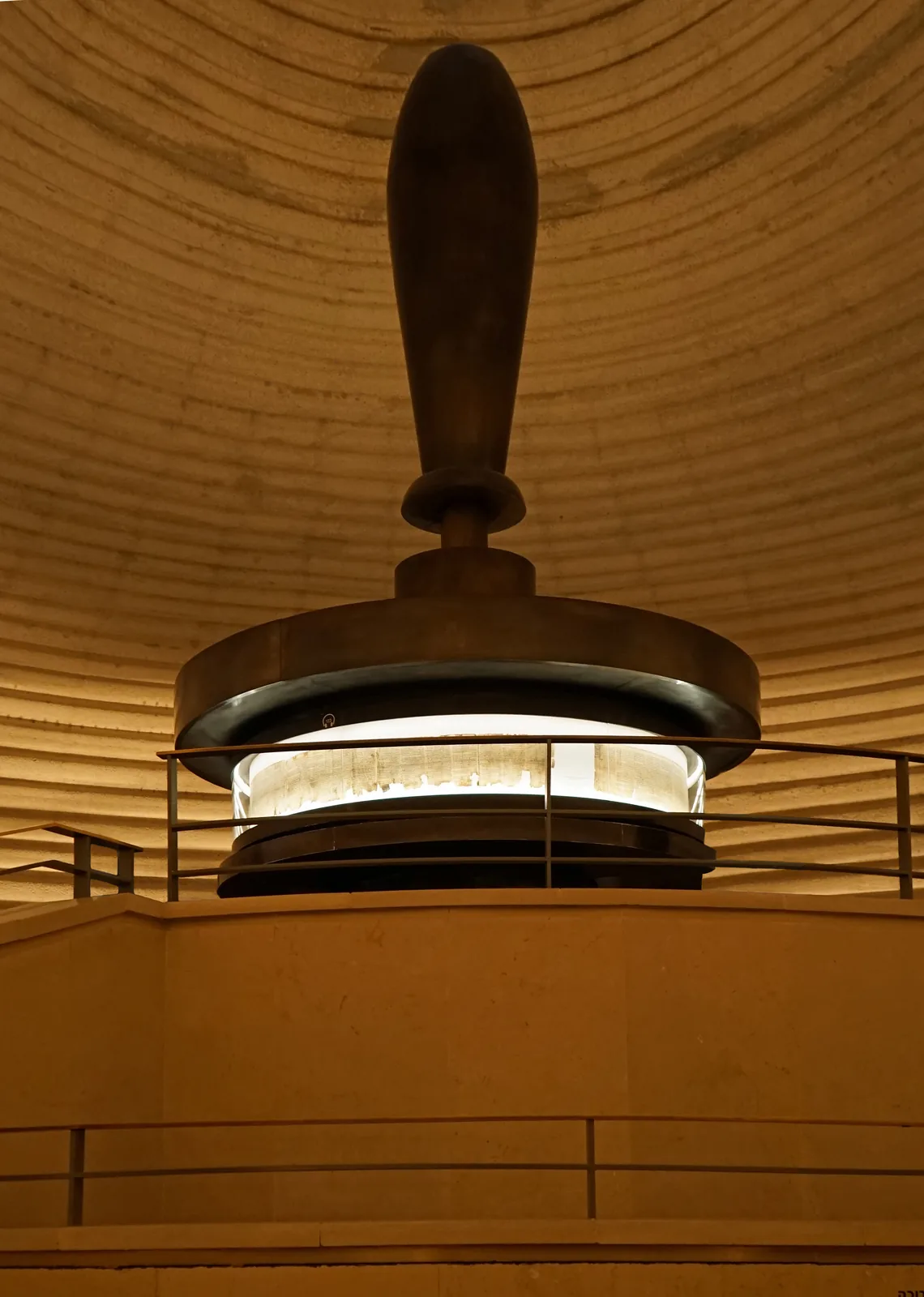
The Great Isaiah Scroll (1QIsaᵃ) on display at the Shrine of the Book, Israel Museum, Jerusalem. This is a photograph of the exhibit, not a studio capture of the scroll off display. The scroll, copied in the second century BC, contains the book of Isaiah.
Photo: Dennis G. Jarvis, via Wikimedia Commons, CC BY-SA 2.0.


Diagram, not to scale. Original diagram by Evidencepage.
Original diagram by Evidencepage. © 2026 Evidencepage.
The story
In 1947 Bedouin of the Ta'amireh tribe found seven scrolls in a cave near Khirbet Qumran, on the northwest shore of the Dead Sea; the cave was later named Cave 1. One was a complete copy of Isaiah. Between 1949 and 1956, Bedouin and an expedition led by Roland de Vaux found the remains of more than 900 texts in ten more caves.[S9][S7]
The Great Isaiah Scroll, 1QIsaᵃ, is 734 cm long. Its 54 columns hold all 66 chapters of Isaiah, and the Israel Museum calls it the only biblical scroll that is almost complete. The museum holds it in the Shrine of the Book as HU 95.57/27. Millar Burrows published it in 1950, and Eugene Ulrich and Peter Flint's critical edition (DJD XXXII) completed the official series.[S6][S17]
Two kinds of evidence date it. Script specialists placed it in the second half of the second century BCE; Frank Cross gave about 150–125 BCE. In 1995 the Arizona radiocarbon laboratory dated a sample of the scroll to 335–122 BC at one standard deviation, and to 356–291 BC (24%) or 250–103 BC (76%) at two. A Zurich test on the same scroll agreed. The museum dates it to about 125 BCE, some thousand years before the oldest Hebrew Bible manuscripts known before 1947.[S1][S21][S6]
Close is not the same as identical. The museum says the scroll generally conforms to the Masoretic text but has well over 2,600 variants, from single letters to whole verses. The second half of Isaiah 2:9 and all of 2:10 are missing. Got Questions says none of the variants changed the meaning. Anthony Ferguson, writing for the Text & Canon Institute at Midwestern Baptist Theological Seminary, calls the differences real but often minor.[S6][S8][S12]
At Isaiah 53:11, in the Servant passage, 1QIsaᵃ reads "he will see light". The second Cave 1 Isaiah scroll, a Cave 4 copy and the Greek translation have the same word, and the Masoretic text lacks it. John Meade, writing on the Evangelical Textual Criticism blog, judges the longer reading probably earlier.[S13][S16]
Across the caves, Eugene Ulrich finds variant editions of books such as Exodus and Jeremiah, though Isaiah survives in one edition with distinct manuscript families. Who collected the scrolls is still argued: the museum says probably a group of Essenes, while the Israel Antiquities Authority says that consensus has been challenged and modified. No Christian texts were found among them.[S15][S10][S25][S27]
Key findings
| Finding | Sources |
|---|---|
A near-complete Isaiah from Cave 1Found in 1947 among the first seven scrolls from Cave 1 near Qumran. It is 734 cm long, with 54 columns holding all 66 chapters, and is held by the Israel Museum as HU 95.57/27. | S9 S7 S17 S6 S12 S21 |
Dated to the last centuries BCE by script and radiocarbonPalaeographers date it to the second half of the second century BCE (Cross: about 150–125 BCE). A 1995 radiocarbon test on a sample gave 335–122 BC at one standard deviation, and a Zurich test agreed. That puts it about a thousand years before the medieval Masoretic codices. | S1 S21 S2 S11 S6 S12 |
Close to the Masoretic text, not identicalThe text generally conforms to the Masoretic version, but the Israel Museum counts well over 2,600 variants. Isaiah 2:9b–10 is missing, and at 53:11 the scroll reads "he will see light". The claim that no variant changes the meaning does not hold. | S6 S12 S15 S8 S13 S16 |
Several text forms were in useUlrich finds variant editions of several biblical books among the scrolls. For Isaiah he finds one edition but distinct manuscript families, with 1QIsaᵃ on one side and 1QIsaᵇ and the Masoretic text on the other. | S6 S15 S12 S17 |
Essenes and the dates are still argued; Jesus is not in the scrollsEssene ownership is disputed. Challenges to the radiocarbon dates centre on castor-oil contamination, which would make dates too young, not too old. The Israel Antiquities Authority says no Christian texts were found among the manuscripts. | S10 S25 S26 S18 S3 S19 S20 S21 S27 S1 |
Labels and sources are taken from the linked claims, so they stay in step with the ledger. How we label evidence.
Where scholars land
Conservative
Anthony Ferguson (Text & Canon Institute, 2022)
Anthony Ferguson holds that 1QIsaᵃ is strong indirect evidence for the antiquity of the Masoretic Text of Isaiah: where the two disagree, the Masoretic reading is usually more original. He is very confident the Old Testament copies are a reliable guide to the original, but warns that one famous scroll cannot carry that case alone.
Critical
Eugene Ulrich (University of Notre Dame; co-editor of DJD XXXII)
Eugene Ulrich reads the biblical scrolls as evidence of pluriform, developing texts. Several books circulated in variant editions side by side for centuries. Isaiah survives in a single edition, but in distinct manuscript families, 1QIsaᵃ against 1QIsaᵇ and the Masoretic text. His edition with Flint judges that one scribe copied 1QIsaᵃ.
Skeptical
Kaare Lund Rasmussen and colleagues (Radiocarbon, 2001 and 2009)
Kaare Lund Rasmussen and colleagues argue that castor oil used by the 1950s editors may not have been removed by the cleaning used in the 1990s radiocarbon tests, so those dates cannot be guaranteed. Any contamination would make dates too young. They propose a better cleaning protocol and call for redating.
Each column states a position in that scholar or institution's own best terms, with a named source.
Records vs. retellings
What people often say
The Dead Sea Isaiah scroll is identical to the Bible we read today.
What the object or text actually says
The Israel Museum says the scroll generally conforms to the Masoretic text, in the same chapter order, but has well over 2,600 variants, from single letters to whole verses.
Where it stands
Close, not identical. Even the conservative scholar Anthony Ferguson calls the differences real, though often minor, and warns against resting the reliability of the whole Old Testament on this one scroll.
Claims 6, 8 ↓What people often say
None of the variants change the meaning of the text.
What the object or text actually says
1QIsaᵃ lacks Isaiah 2:9b–10, and at 53:11 it reads "he will see light" where the Masoretic text has no word for light.
Where it stands
Contradicted by the scroll itself. Most variants are spelling and scribal slips, but some change what a verse says. The Israel Museum says the variants have literary, historical and theological implications.
Claims 7–8 ↓What people often say
The Dead Sea Scrolls talk about Jesus and the first Christians.
What the object or text actually says
The Israel Antiquities Authority says rabbinic and Christian texts were not found among the manuscripts. 1QIsaᵃ is a copy of Isaiah dated before the first century CE.
Where it stands
No direct evidence. Rodley and Thiering (1999) argued that the dates leave room for a sect leader contemporary with early Christianity, and said themselves that this went against the common view.
Claims 15–16 ↓What people often say
The Essenes wrote the Dead Sea Scrolls.
What the object or text actually says
The Israel Museum says most scholars believe the Qumran site housed a sect, probably a group of Essenes. The Israel Antiquities Authority says scholars once tied all the scrolls to the Essenes, and that this consensus has been challenged and modified.
Where it stands
Disputed. Many scholars still link the scrolls to the Essenes. Others see several related groups, or scrolls hidden by rebels fleeing Jerusalem.
Claim 13 ↓The object
Great Isaiah Scroll (1QIsaᵃ)
- Name
- Great Isaiah Scroll (1QIsaᵃ)
- Provenance
- museum-documented
- Findspot
- Qumran Cave 1, near Khirbet Qumran on the northwest shore of the Dead Sea
- Found
- 1947
- Holder
- Israel Museum, Jerusalem (Shrine of the Book); Government of Israel
- Catalog
- HU 95.57/27 (Israel Museum accession number)
- Peer review
- published
- Announced by
- independent
- Notes
- Found by Bedouin, not in a controlled excavation, so 'museum-documented' is used rather than 'excavated'. The IMJ and IAA pages give the chain of custody: bought by the Syrian Orthodox Metropolitan Mar Athanasius Samuel, photographed in 1948 by John Trever of the American Schools of Oriental Research, taken to the United States (IMJ says 1948, IAA says 1949), advertised in the Wall Street Journal on 1 June 1954, bought for Israel by Yigael Yadin, and shown in the Shrine of the Book since 1965. Parchment; H 22–25 cm, L 734 cm (IMJ). First edition by Millar Burrows (ASOR, 1950) per Holmstedt (S17). The official Discoveries in the Judaean Desert edition is cited from later reports; S6 and S17 stand in for it.
- Primary publication
- S6
Bible references
References only. Verse text is not reproduced here.
- Isaiah 2:9-10 The second half of verse 9 and all of verse 10 are absent from 1QIsaᵃ
- Isaiah 2:4 The swords-into-plowshares passage the Israel Museum quotes from the scroll's book
- Isaiah 7:14 A verse often checked against the Great Isaiah Scroll; this entry makes no claim about its reading
- Isaiah 40:8 Often cited when the scroll is used to argue for a stable text; this entry makes no claim about its reading
- Isaiah 52:13-53:12 The Servant passage that contains the 53:11 variant
- Isaiah 53:11 1QIsaᵃ, 1QIsaᵇ, 4QIsaᵈ and the Septuagint read "he will see light"; the Masoretic text lacks "light"
- Luke 4:17-19 Jesus is handed a scroll of Isaiah in the Nazareth synagogue, a reminder that Isaiah circulated as a scroll
Timeline
| Date | What happened | Sources |
|---|---|---|
| 150-125 BCE | Frank Cross's palaeographic date for 1QIsaᵃ, as cited by Jull et al.; the Israel Museum gives about 125 BCE. | S1 S6 |
| 1947 | Bedouin find the first seven scrolls, including 1QIsaᵃ, in Cave 1 near Qumran. | S9 S7 |
| 1948 | John Trever photographs the three St. Mark's Monastery scrolls, including the complete Isaiah. | S7 |
| 1949-1956 | Bedouin and the expedition of Roland de Vaux and Gerald Lankester Harding find fragments in ten more caves; Cave 11 is found in 1956. | S9 S7 |
| 1950 | Millar Burrows publishes the first edition of 1QIsaᵃ for the American Schools of Oriental Research. | S17 |
| 1954-06-01 | Mar Samuel's four scrolls are advertised in the Wall Street Journal; Yigael Yadin buys them for Israel. | S7 S9 |
| 1965 | The Shrine of the Book opens at the Israel Museum to house the seven Cave 1 scrolls. | S7 S9 |
| 1992 | Bonani et al. publish the Zurich AMS dates for 14 scrolls. | S2 |
| 1995 | Jull et al. publish the Arizona AMS dates, including 1QIsaᵃ. | S1 |
| 1999 | Rodley and Thiering argue that the radiocarbon dates leave room for a link to early Christianity. | S21 |
| 2001 | Rasmussen et al. raise castor-oil contamination; Carmi replies in 2002 and Rasmussen's team answers in 2003. | S18 S3 S19 |
| 2009 | Rasmussen et al. publish a cleaning protocol for castor oil and call for redating. | S20 |
| 2010 | Ulrich and Flint's DJD XXXII, the critical edition of the two Cave 1 Isaiah scrolls, appears and completes the DJD series. | S17 |
| 2020-03-13 | National Geographic reports that all 16 Museum of the Bible fragments are modern forgeries. | S24 S23 |
Competing explanations
Isaiah 2:9b–10 is a later addition in the other witnesses
- Case for
- The Israel Museum's curator reads the absence of these lines in 1QIsaᵃ as evidence that they were added, though early, to an older form that the scroll preserves (S6).
- Case against
- The lines are present in 4QIsaᵃ, 4QIsaᵇ and the Hebrew behind the Septuagint (S6). Ferguson's general point is that where 1QIsaᵃ and the Masoretic text disagree, scholars most often judge the Masoretic reading more original, since many 1QIsaᵃ differences come from scribal habit or error (S12). He does not discuss this passage.
- What would settle it
- A direct reading of the official edition notes on Isaiah 2, and of Ulrich's work on additions in the Masoretic text, would show how the editors judge this case.
- Sources
- S6 S12
The scrolls were the library of a sect at Qumran, probably Essenes
- Case for
- The Israel Museum says most scholars believe the site housed a reclusive sect, probably Essenes, whose library was hidden in the caves before the Roman army arrived in 68 CE (S10). The IAA says many scholars still link the Essenes and the scrolls (S25).
- Case against
- The IAA says most now see the writings of related, evolving communities rather than a single sect (S26). The museum reports a theory that rebels fleeing Jerusalem hid some or all of the scrolls (S10).
- What would settle it
- Further work on who wrote, copied and owned the scrolls; the sources opened here name no single test that would decide it.
- Sources
- S10 S25 S26
What would settle it
- A redating of 1QIsaᵃ samples using the castor-oil cleaning protocol of Rasmussen et al. (2009) would confirm or shift the 1990s ranges.
- An open text by a named proponent of the Jerusalem-origin view would let that side speak in its own words.
What remains unknown
- Exactly when within the second century BCE the scroll was copied.
- Whether any of the dated 1QIsaᵃ samples was touched by castor oil.
- Who owned and hid the Qumran scrolls, and whether all of them came from one group.
- Whether 1QIsaᵃ was copied by one scribe or two.
All 17 claims, each labelled and sourced
All 17 claims, each labelled and sourced
| Claim | Evidence | Status | Sources | Checked |
|---|---|---|---|---|
| 1.In 1947 Bedouin of the Ta'amireh tribe found the first seven scrolls in a cave near Khirbet Qumran, later named Cave 1. From 1949 to 1956 Bedouin and an expedition directed by Roland de Vaux found fragments in ten more caves, the last of them Cave 11 in 1956; the Israel Antiquities Authority puts the total at over 900 manuscripts. | Confirmed | Broad consensus | S9 S7 S17 | 2026-11-21 |
| 2.1QIsaᵃ is one of the original seven scrolls from Cave 1. It is a parchment scroll 734 cm long whose 54 columns contain all 66 chapters of Isaiah; the Israel Museum calls it "the only one that is almost complete" of the biblical scrolls. It is held in the Shrine of the Book, accession number HU 95.57/27. | Confirmed | Broad consensus | S6 S17 S12 S7 | 2026-11-21 |
| 3.In the 1995 Arizona AMS series, a sample of 1QIsaᵃ gave calibrated ages of 335–122 BC at one standard deviation, and 356–291 BC (24%) or 250–103 BC (76%) at two standard deviations. Rodley and Thiering note that the Zurich series (Bonani et al. 1992) also measured 1QIsa and that the Arizona value is in good agreement with it. Both series report radiocarbon ages that broadly match the script dates. | Confirmed | Broad consensus | S1 S21 S2 S11 Against: S18 | 2026-11-21 |
| 4.Palaeography (the study of handwriting) dates 1QIsaᵃ to the second half of the second century BCE. Jull et al. cite Frank Cross for about 150–125 BCE and Nahman Avigad for the second half of that century. The Israel Museum gives about 125 BCE, and Ferguson the second century BC. | Confirmed | Majority view | S6 S1 S12 | 2026-11-21 |
| 5.The Israel Museum calls 1QIsaᵃ "some one thousand years older than the oldest manuscripts of the Hebrew Bible known to us before the scrolls' discovery", and names the tenth-century Aleppo Codex as the finest example of the Masoretic text. Ferguson says the Masoretic text is best represented by medieval codices from around 1000 AD. | Confirmed | Broad consensus | S6 S12 | 2026-11-21 |
| 6.The text of 1QIsaᵃ generally conforms to the Masoretic text, with all 66 chapters in the same order. Ferguson says that once minor differences such as spelling are set aside it is quite close to the Masoretic text, and that where they disagree scholars most often judge the Masoretic reading more original. | Consistent | Majority view | S6 S12 S15 | 2026-11-21 |
| 7.Overclaim: the scrolls show an "astonishing lack of variants" and "none of the variants changed the meaning of the text" (Got Questions). The Israel Museum counts well over 2,600 variants in 1QIsaᵃ, from a single letter to whole verses, and says they have "obvious literary, historical and theological implications"; two are given in the next claim. | Contradicted | Majority view | S8 S6 S12 | 2026-11-21 |
| 8.Two variants change what the text says. The second half of Isaiah 2:9 and all of 2:10 are absent from 1QIsaᵃ, though 4QIsaᵃ, 4QIsaᵇ and the Hebrew behind the Septuagint have them. At Isaiah 53:11, 1QIsaᵃ reads "he will see light", as do 1QIsaᵇ, 4QIsaᵈ and the Septuagint, while the Masoretic text lacks "light". | Confirmed | Broad consensus | S6 S13 S16 | 2026-11-21 |
| 9.Which reading at Isaiah 53:11 is earlier is a judgment. Meade argues the longer reading with "light" is probably earlier, because independent witnesses agree and the word could easily have dropped out by a copying slip. He notes that the Jewish revisers Aquila, Symmachus and Theodotion already have the shorter text, and that the NIV and CSB follow the longer one while not every English translation does. | n/a | Disputed | S13 S16 | 2026-11-21 |
| 10.Several text forms of biblical books circulated in the Qumran period. The Israel Museum says the scrolls show several concurrent versions, one of them (the proto-Masoretic) having a special status. Ulrich lists variant editions for Exodus, Numbers, Joshua, Jeremiah, Ezekiel, Daniel, the Twelve and Psalms; for Isaiah he finds a single edition with different manuscript families (1QIsaᵃ against 1QIsaᵇ and the Masoretic text). | Confirmed | Broad consensus | S6 S15 S12 | 2026-11-21 |
| 11.Around twenty further copies of Isaiah were found at Qumran, plus one at Wadi Murabba'at, along with six commentaries (pesharim) on Isaiah, according to the Israel Museum. Rodley and Thiering also list six Isaiah pesharim. | Confirmed | Broad consensus | S6 S21 | 2026-11-21 |
| 12.Ulrich and Flint's DJD edition concludes that "a single scribe originally copied the entire book", with later hands adding corrections. Martin Abegg's linguistic profile in the same volume finds a break between columns 27 and 28 (the end of Isaiah 33). The reviewer Robert Holmstedt finds the editors' explanation of that break thin. | n/a | Disputed | S17 | 2026-11-21 |
| 13.Whether the scrolls were an Essene library is disputed. The Israel Museum says most scholars believe Qumran housed a sect, probably Essenes, and that the scrolls were their library, but it also reports an alternative theory that rebels fleeing Jerusalem hid some or all of them. The Israel Antiquities Authority says the early Essene consensus has been "challenged and modified", and that most now see the writings of related, evolving communities rather than a single sect. | n/a | Disputed | S10 S25 S26 | 2026-11-21 |
| 14.Castor-oil contamination skewed the published radiocarbon dates. Rasmussen et al. (2001) found that the standard cleaning may not remove castor oil, so contaminated samples would date too young "by an unknown amount" (at most about 300 radiocarbon years for a fully soaked sample, as their 2009 paper reports). Carmi (2002) judged the cleaning adequate, and Rasmussen's team replied in 2003. No source opened here reports a redating of 1QIsaᵃ with the newer protocol. | No direct evidence | Disputed | S18 S3 S19 S20 | 2026-11-21 |
| 15.Rodley and Thiering (1999) used published radiocarbon dates for some sectarian scrolls, not the Isaiah scroll, to argue that their Teacher of Righteousness could have lived when Christianity began, a view they themselves called contrary to the commonly held one. Their paper treats the Isaiah scroll's dates from the Arizona and Zurich labs as in good agreement. | n/a | Majority view | S21 | 2026-11-21 |
| 16.Pitfall: the scrolls are sometimes said to mention Jesus or the first Christians. The Israel Antiquities Authority says that rabbinic and Christian texts were not found among the manuscripts, though ideas in the scrolls resurface in later Jewish and Christian writings. 1QIsaᵃ itself is a copy of Isaiah dated before the first century CE. | No direct evidence | Broad consensus | S27 S21 S1 | 2026-11-21 |
| 17.The Museum of the Bible's 16 "Dead Sea Scroll" fragments, which the museum says lack credible provenance, were judged modern forgeries; the museum's page reports that its advisory team found none of them authentic. They are not part of the excavated Qumran finds and do not bear on 1QIsaᵃ. | Forgery/Debunked | Broad consensus | S23 S24 | 2026-11-21 |
Evidence: what the object, inscription or text supports. A Documented record tag marks a purchase, edition, test, retraction or disclosure. Status: how far specialists agree. How we label evidence.
Sources
- S1A. J. Timothy Jull, Douglas J. Donahue, Magen Broshi and Emanuel Tov, “Radiocarbon Dating of Scrolls and Linen Fragments from the Judean Desert”, Radiocarbon 37.1 (1995), pp. 11-19, 1995.peer-reviewedTier 1neutral Link · accessed 2026-11-21
Note: Open-access PDF read. Table 2 row AA-14984 (DSS-50, 1QIsaᵃ, 5 runs): 1σ 335-122 BC; 2σ 356-291 BC (24%), 250-103 BC (76%); palaeographic date 150-125 BC. Appendix 1 quotes Cross (1992) and Avigad (1965). The radiocarbon age in years BP did not come through the text extraction and is not quoted. Shares Magen Broshi with S2. - S2Georges Bonani, Susan Ivy, Willy Wölfli, Magen Broshi, Israel Carmi and John Strugnell, “Radiocarbon Dating of Fourteen Dead Sea Scrolls”, Radiocarbon 34.3 (1992), pp. 843-849, 1992.peer-reviewedTier 1neutral Link · accessed 2026-11-21
Note: Publisher page and abstract read; the PDF was opened, but its results table is an image and could not be read. That Zurich also measured 1QIsa is taken from S21, not from this table. - S3Israel Carmi, “Are the 14C Dates of the Dead Sea Scrolls Affected by Castor Oil Contamination?”, Radiocarbon 44.1 (2002), pp. 213-216, 2002.peer-reviewedTier 1neutral Link · accessed 2026-11-21
Note: Publisher page and abstract read; the PDF is an image scan. Carmi was a co-author of S2. - S6The Israel Museum, Jerusalem (text signed by Adolfo D. Roitman, Curator of the Dead Sea Scrolls), “The Great Isaiah Scroll (1QIsa a), The Digital Dead Sea Scrolls”, The Israel Museum, Jerusalem, undated web page.museum recordTier 1neutral Link · Archive · accessed 2026-11-23
Note: The https URL in the plan fails to connect; the http URL loads. The header line says "1st century BCE", but the text gives "ca. 125 BCE" and "the last third of the second century BCE". - S7Israel Antiquities Authority, “Discovery and Publication, The Leon Levy Dead Sea Scrolls Digital Library”, Israel Antiquities Authority, undated web page.institutionalTier 1neutral Link · accessed 2026-11-21
Note: The plan's 1QIsa item path (/explore-the-archive/manuscript/1QIsa-1) still returns the site's 404 page. No working 1QIsaᵃ item page was found in the library; the scroll is held by the Israel Museum, not the IAA. - S8GotQuestions.org, “What are some exciting discoveries in biblical archaeology?”, Got Questions Ministries, undated web page.advocacyTier 3conservative Link · accessed 2026-11-21
Note: Used only as the example of the overclaim corrected in claim no-meaningful-differences, not as the conservative scholarly voice. - S9The Israel Museum, Jerusalem, “Discovery, The Digital Dead Sea Scrolls”, The Israel Museum, Jerusalem, undated web page.museum recordTier 1neutral Link · Archive · accessed 2026-11-23
- S10The Israel Museum, Jerusalem, “The Qumran Community, The Digital Dead Sea Scrolls”, The Israel Museum, Jerusalem, undated web page.museum recordTier 1neutral Link · Archive · accessed 2026-11-23
- S11The Israel Museum, Jerusalem, “Nature and Significance, The Digital Dead Sea Scrolls”, The Israel Museum, Jerusalem, undated web page.museum recordTier 1neutral Link · Archive · accessed 2026-11-23
Note: Says the scrolls were dated by palaeography and radiocarbon to between the third century BCE and the first century CE. - S12Anthony Ferguson, “How Much Can the Most Famous Dead Sea Scroll Prove?”, Text & Canon Institute (Midwestern Baptist Theological Seminary), 2022-01-11.institutionalTier 2conservative Link · accessed 2026-11-21
Note: The source's own title is kept unchanged. The author bio gives a PhD from The Southern Baptist Theological Seminary, with a dissertation comparing Qumran's non-aligned texts with the Masoretic text. - S13John Meade, “"He will see light" in Isaiah 53:11”, Evangelical Textual Criticism (blog), 2020-04-10.blogTier 3conservative Link · accessed 2026-11-21
Note: Lists the Hebrew of 1QIsaᵃ, 1QIsaᵇ and 4QIsaᵈ, the Greek, and the Masoretic text, with images from the Digital Dead Sea Scrolls and the Leon Levy library. - S14GotQuestions.org, “What are the Dead Sea Scrolls and why are they important?”, Got Questions Ministries, undated web page.advocacyTier 3conservative Link · accessed 2026-11-21
Note: Says there were "minimal differences" between the Qumran and previously known manuscripts, and that fragments of every book except Esther were found; the Israel Museum (S11) says every book except Nehemiah and Esther. Not used for any claim beyond sourcing_notes. - S15Eugene Ulrich, “Variant Editions of Biblical Books Revealed by the Qumran Scrolls”, In A. B. Perrin, K. S. Baek and D. K. Falk (eds), Reading the Bible in Ancient Traditions and Modern Editions: Studies in Memory of Peter W. Flint (SBL Press, Early Judaism and Its Literature 47), pp. 13-34, 2017.academic bookTier 2critical Link · accessed 2026-11-21
Note: Full-volume PDF hosted on SBL's own site; chapter read. Chapter DOI 10.2307/j.ctt1wn0sft.6 (Crossref). - S16Kyung S. Baek and Andrew B. Perrin, “Preface, Reading the Bible in Ancient Traditions and Modern Editions: Studies in Memory of Peter W. Flint”, SBL Press (Early Judaism and Its Literature 47), 2017.academic bookTier 2neutral Link · accessed 2026-11-21
Note: Gives the 1QIsaᵃ reading at Isa 53:11 ("he will see light") from the DJD XXXII Hebrew text and the Abegg, Flint and Ulrich translation, and says the passage was a regular example in Flint's teaching. Same volume as S15, different authors. - S17Robert D. Holmstedt, “Review of Ulrich and Flint, Qumran Cave 1, II: The Isaiah Scrolls (DJD XXXII)”, Journal of Hebrew Scriptures 12 (2012), review essay, 2013-09-23.peer-reviewedTier 1neutral Link · accessed 2026-11-21
Note: Full review read (HTML galley). Reports the 54 columns of 1QIsaᵃ, Burrows's 1950 first edition, the single-scribe conclusion (DJD XXXII p. 63) and Abegg's column 27/28 data. - S18Kaare L. Rasmussen, Johannes van der Plicht, Frederick H. Cryer, Gregory Doudna, Frank M. Cross and John Strugnell, “The Effects of Possible Contamination on the Radiocarbon Dating of the Dead Sea Scrolls I: Castor Oil”, Radiocarbon 43.1 (2001), pp. 127-132, 2001.peer-reviewedTier 1skeptical Link · accessed 2026-11-21
Note: Publisher page and abstract read. Side marked skeptical because it questions the reported dates, not the scrolls' antiquity. - S19Kaare L. Rasmussen, Johannes van der Plicht, Gregory Doudna, Frank M. Cross and John Strugnell, “Reply to Israel Carmi (2002): "Are the 14C Dates of the Dead Sea Scrolls Affected by Castor Oil Contamination?"”, Radiocarbon 45.3 (2003), pp. 497-499, 2003.peer-reviewedTier 1skeptical Link · accessed 2026-11-21
Note: Publisher page and abstract read. - S20Kaare Lund Rasmussen, Johannes van der Plicht, Gregory Doudna, Frederik Nielsen, Peter Højrup, Erling Halfdan Stenby and Carl Th. Pedersen, “The Effects of Possible Contamination on the Radiocarbon Dating of the Dead Sea Scrolls II: Empirical Methods to Remove Castor Oil and Suggestions for Redating”, Radiocarbon 51.3 (2009), pp. 1005-1022, 2009.peer-reviewedTier 1skeptical Link · accessed 2026-11-21
Note: Open-access PDF read (text extracted). - S21G. A. Rodley and B. E. Thiering, “Use of Radiocarbon Dating in Assessing Christian Connections to the Dead Sea Scrolls”, Radiocarbon 41.2 (1999), pp. 169-182, 1999.peer-reviewedTier 1skeptical Link · accessed 2026-11-21
Note: Open-access PDF read (text extracted). States that the Tucson (S1) and Zurich (S2) series share one document, 1QIsa, and that the Tucson value is in good agreement with Zurich. The conclusion presents its Christian-connection reading as contrary to the commonly held view. - S23Museum of the Bible, “A Journey for the Truth: Investigating the Recent Dead Sea Scrolls Fragments”, Museum of the Bible, undated web page.museum recordTier 1neutral Link · accessed 2026-11-21
- S24Michael Greshko, “'Dead Sea Scrolls' at the Museum of the Bible are all forgeries”, National Geographic, 2020-03-13.journalismTier 2neutral Link · accessed 2026-11-21
- S25Israel Antiquities Authority, “Introduction, The Leon Levy Dead Sea Scrolls Digital Library”, Israel Antiquities Authority, undated web page.institutionalTier 1neutral Link · accessed 2026-11-21
- S26Israel Antiquities Authority, “Scrolls Content, The Leon Levy Dead Sea Scrolls Digital Library”, Israel Antiquities Authority, undated web page.institutionalTier 1neutral Link · accessed 2026-11-21
- S27Israel Antiquities Authority, “Historical Background, The Leon Levy Dead Sea Scrolls Digital Library”, Israel Antiquities Authority, undated web page.institutionalTier 1neutral Link · accessed 2026-11-21
Note: In the page HTML the sentence on rabbinic and Christian texts is split by an image caption, so it is paraphrased rather than quoted.
Tier 1 is a primary record: a museum record, excavation report, edition or peer-reviewed paper. Tier 3 sources are cited as the views of those organizations. How we label evidence.
Evidence log
- The first seven scrolls, including 1QIsaᵃ, were found in Cave 1 (S9, S7).
- Burrows published the first edition of 1QIsaᵃ (S17).
- The Zurich AMS series dated 14 scrolls (S2); by S21's account it included 1QIsa.
- The Arizona AMS series gave the 1QIsaᵃ ranges used here (S1).
- The castor-oil question was raised (S18), answered by Carmi (S3, 2002), and replied to (S19, 2003).
- A castor-oil cleaning protocol was proposed and redating recommended (S20).
- DJD XXXII, the critical edition of the Cave 1 Isaiah scrolls, completed the official series (S17).
- Entry first written.
- Scripture policy review: no change to the biblical claims; process wording cleaned for the validator.
- update Sources list tightened: each claim now cites only sources we opened and checked, and a few sentences we couldn't check were removed.
Read next
Museum of the Bible's fake "Dead Sea Scroll" fragments (2009–2020)
The Museum of the Bible fragments that were sold as Dead Sea Scrolls and found to be modern forgeries.
The Pilate stone (Caesarea, 1961)
Another object entry, where an excavated, museum-held inscription carries the evidence.
Hezekiah's tunnel and the Siloam inscription (Jerusalem, found 1880)
Another entry where radiocarbon dates and script dates are weighed against each other.