Objects and inscriptions
The Pilate stone (Caesarea, 1961)
A broken limestone block from Caesarea names Pontius Pilate as prefect of Judea. It confirms he held the office of governor of Judea under Tiberius, as Luke 3:1 and the Gospel trial accounts say.
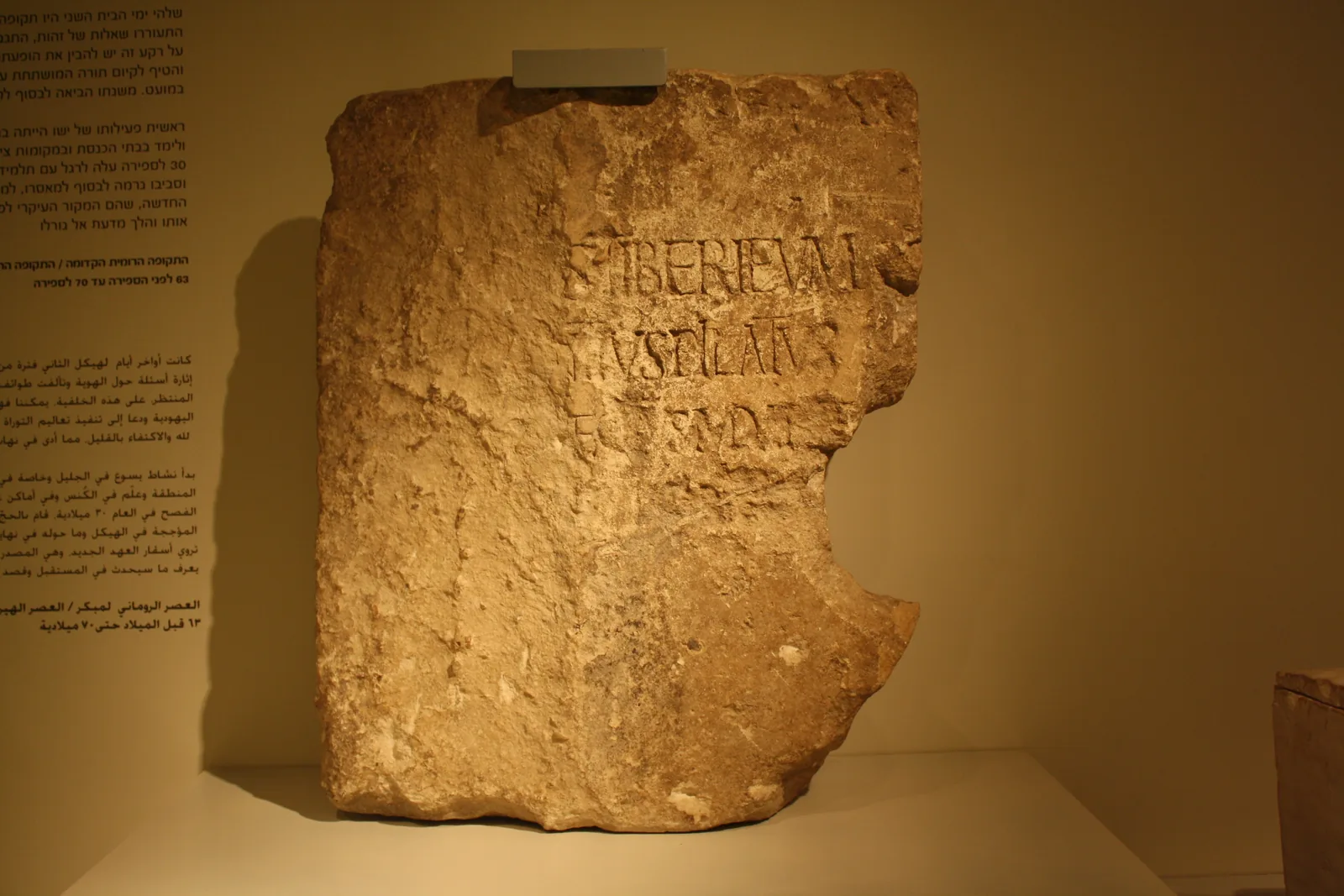
The Pilate stone (original), Israel Museum, Jerusalem. Found at Caesarea Maritima in 1961. The name Pontius Pilate and his title as prefect of Judea survive on the stone.
Photo: BRBurton, via Wikimedia Commons, CC0 1.0.


Transcription of the surviving Latin, with restorations in brackets. PILATVS and TIBERIEVM stand on the stone. The letters in brackets are restored, following the CIIP edition for lines 2 and 3. Most of line 1 and nearly all of line 4 are lost; what the Tiberieum was remains debated. Diagram, not to scale.
Original diagram by Evidencepage. © 2026 Evidencepage.
The story
In 1961, during the Italian excavations at Caesarea Maritima, a limestone block was found reused as a step in the Roman theater. The stone's entry in CIIP (Corpus Inscriptionum Iudaeae/Palaestinae, the standard edition of the region's inscriptions) says the stone had been moved from an original setting that is unknown, first possibly as a well head and then, in the fourth century CE, as a step in the theatre. The Israel Museum in Jerusalem holds it as IAA 1961-529.[S2][S6][S1]
Four lines were cut in Latin, and only parts survive. The second line keeps the letters NTIVS PILATVS, which editors restore as [Po]ntius Pilatus. The third keeps ECTVS IVDA, then a gap, then E, restored as [praef]ectus Iudae[a]e, prefect of Judea. The CIIP record credits Antonio Frova with reconstructing these two lines in his 1961 article. The first line ends TIBERIEVM, a structure named for the emperor Tiberius. Almost all of the fourth line is gone.[S2][S1]
The title matters. Tacitus, describing the execution of Christus, says it happened "at the hands of one of our procurators, Pontius Pilatus." Josephus, in Whiston's translation, says Pilate was "sent as procurator into Judea by Tiberius." The stone, cut during Pilate's own term, uses prefect. Even the Israel Museum's page calls him "the fifth Roman Procurator of Judea," while the stone it displays reads [praef]ectus, prefect.[S7][S12][S1][S6]
What the Tiberieum was is still argued. The museum says the block was probably set into a temple honoring Tiberius. Joan Taylor reads the stone as Pilate dedicating a Tiberieum to the Dis Augustis, the deified emperors. In 1999 Géza Alföldy proposed reading the first line as [Nauti]s and the last as [ref]eci[t], so that Pilate restored a harbor lighthouse for the sailors. The CIIP record says this reading was widely accepted and that the temple idea "has now largely been dismissed"; Taylor's 2006 article, written after Alföldy's, still argues for the imperial-cult reading. Both versions rest on restored letters.[S1][S5][S2][S3]
The Israel Museum calls the stone the only object from Pilate's time that bears his name. A copper-alloy ring from Herodium, published in 2018, may read ΠΙΛΑΤΟ (Pilato). Its own editors doubted that the prefect himself wore it, and later studies disagree about both the reading and the owner.[S1][S14][S17][S18]
So the stone places Pontius Pilatus in office as prefect of Judea under Tiberius, as Luke 3:1 records. The stone itself does not mention Jesus. His trial and execution under Pilate are recorded in all four Gospels, and two writers outside the church agree: Tacitus says Christus was executed under Pontius Pilatus, and a passage in Josephus whose statement that Pilate condemned Jesus is generally held to be authentic says the same.[S7][S21]
Key findings
| Finding | Sources |
|---|---|
An excavated, museum-held inscription names PilateThe block was found in 1961 in the Italian excavations at Caesarea, reused as a theater step. The Israel Museum holds the original as IAA 1961-529 and dates it to 26–36 CE. Its second line keeps the letters PILATVS, restored as [Po]ntius Pilatus. | S2 S6 S1 S3 S8 |
It calls him prefect, not procuratorThe third line is restored as [praef]ectus Iudae[a]e, prefect of Judea. Tacitus and Josephus (in the English translations used here) call Pilate procurator, and the Israel Museum's own page title repeats that word. The stone is the contemporary witness for the title. | S2 S1 S6 S3 S7 S12 |
What he built or restored is debatedThe word TIBERIEVM survives, but most of line 1 and nearly all of line 4 are lost. The museum and Joan Taylor connect the Tiberieum with a temple or the imperial cult. Géza Alföldy restored the lines to make it a harbor lighthouse, a reading the CIIP record calls widely accepted. | S2 S1 S5 S3 S4 |
The only object that names him securelyThe Israel Museum calls it the only object from Pilate's time that bears his name. A ring from Herodium published in 2018 may read Pilato, but its reading and any link to the prefect are disputed. | S1 S14 S17 S18 |
It confirms the governor the Gospels nameThe stone names Pilate, not Jesus. Jesus' trial and execution under Pilate are recorded in the Gospels, and Tacitus and a passage in Josephus agree. Philo and Josephus also describe a harsh governor, which fits Luke 13:1, where Pilate mingles the blood of Galileans with their sacrifices. | S7 S1 S21 S11 S12 S13 S9 |
Labels and sources are taken from the linked claims, so they stay in step with the ledger. How we label evidence.
Where scholars land
Conservative
Associates for Biblical Research (Bryan Windle)
Associates for Biblical Research, through Bryan Windle, presents archaeological and literary evidence for Pilate as a historical person: the Roman prefect of Judea from 26 to 36 CE who condemned Jesus to death, named 56 times in the Gospels. It counts the Caesarea stone, and the Herodium ring as a second artifact bearing his name.
Critical
Joan E. Taylor (New Testament Studies, 2006)
Joan E. Taylor reads the stone as material evidence that Pilate actively promoted Roman religion in Judaea. On her reading he dedicated a Tiberieum to the Dis Augustis. She sets this beside his Roman-style coinage and Philo's account of the shields he set up in Jerusalem.
Each column states a position in that scholar or institution's own best terms, with a named source.
Records vs. retellings
What people often say
Archaeology confirms that Pilate condemned Jesus.
What the object or text actually says
The stone names Pontius Pilatus, his title and a Tiberieum. It does not mention Jesus, a trial or a crucifixion.
Where it stands
The stone confirms Pilate held office in Judea under Tiberius, as the Gospels say. Jesus' trial and execution under Pilate are recorded in the Gospels, and Tacitus (Annals 15.44) and probably Josephus (Antiquities 18.3.3) agree; see the Josephus entry.
Claims 2, 9 ↓What people often say
Pilate was the procurator of Judea.
What the object or text actually says
The stone's third line is restored as [praef]ectus Iudae[a]e, prefect of Judea. Tacitus, and Josephus in Whiston's translation, use procurator; so does the Israel Museum's page title.
Where it stands
The only contemporary inscription gives prefect. The word procurator comes from later writers, and the Center for Online Judaic Studies notes that modern historians long assumed it from them.
Claims 3, 8 ↓What people often say
The stone records Pilate dedicating a temple to Tiberius.
What the object or text actually says
In line 1 only a final S and the word TIBERIEVM survive; in line 4 only one letter, read as E. The verb and the purpose are restorations.
Where it stands
Disputed, though the CIIP record calls the lighthouse reading widely accepted: harbor lighthouse (Alföldy) vs. temple or imperial-cult building (the museum's page, Taylor).
Claims 5, 12 ↓What people often say
The stone you can see at Caesarea is the Pilate stone.
What the object or text actually says
The original is in the Israel Museum, Jerusalem (IAA 1961-529).
Where it stands
One reference site describes the block at Caesarea as a replica cast. Neither the Israel Museum nor the Israel Antiquities Authority has published a statement on this.
Claim 11 ↓The object
Pilate stone (Latin dedicatory inscription naming Pontius Pilate)
- Name
- Pilate stone (Latin dedicatory inscription naming Pontius Pilate)
- Provenance
- excavated
- Findspot
- Caesarea Maritima, reused as a step in the Roman theater (earlier possibly as a well head); original setting unknown
- Found
- 1961
- Holder
- Israel Museum, Jerusalem
- Catalog
- IAA 1961-529
- Peer review
- published
- Announced by
- excavator
- Notes
- Hard limestone. The Israel Museum gives H 80, W 68, D 20 cm; the CIIP record gives H 82, W 65, D 20 cm. The CIIP record lists Antonio Frova, "L'inscrizione di Ponzio Pilato a Caesarea", Rendiconti 95 (1961), pp. 419-34, as the first publication. This page cites the stone through the CIIP II 1277 edition record (S2), the museum record (S1) and Alföldy's 1999 study (S3), which reproduce Frova's readings.
- Primary publication
- S2 S1
Bible references
References only. Verse text is not reproduced here.
- Luke 3:1 Dates John the Baptist's ministry by Tiberius's reign and Pilate's governorship of Judea
- Matthew 27:2 Jesus is handed over to Pilate, called the governor
- Mark 15:1-15 The earliest Gospel account of the trial before Pilate
- Luke 23:1-25 Luke's trial account, in which Pilate repeatedly finds no fault
- John 18:28-19:22 John's trial account, ending with the title Pilate has posted on the cross
- Luke 13:1 Mentions Galileans whose blood Pilate mingled with their sacrifices, an incident known only from Luke
- Acts 4:27 Names Pontius Pilate among those who acted against Jesus
- 1 Timothy 6:13 Refers to Jesus' testimony before Pontius Pilate
Timeline
| Date | What happened | Sources |
|---|---|---|
| 26–36 CE | Pilate's term in Judea as given by the Israel Museum and the CIIP record, and the date range they assign to the inscription. Bond gives 26–37 CE. | S1 S2 S8 |
| 300–399 CE | According to the CIIP record, the block was reused in the fourth century CE as a step in the theater at Caesarea, after an earlier reuse possibly as a well head. | S2 |
| 1961 | The block was found during the Italian excavations of Caesarea Maritima. Antonio Frova's article on it appeared the same year (as listed in the CIIP record). | S2 S6 |
| 1968–1969 | A copper-alloy ring was excavated at Herodium in Gideon Foerster's excavations; it was not published until 2018. | S17 S14 |
| 1999 | Géza Alföldy proposed reading the Tiberieum as a lighthouse restored for the sailors, a reading the CIIP record says was widely accepted. | S2 S3 |
| 2002 | Alföldy published a second article on the inscription, "Nochmals: Pontius Pilatus und das Tiberieum von Caesarea Maritima". | S4 |
| 2006 | Joan E. Taylor argued in New Testament Studies that Pilate dedicated a Tiberieum to the Dis Augustis, as part of promoting the imperial cult in Judaea. | S5 S2 |
| 2018 | The Herodium ring was published in the Israel Exploration Journal with the reading ΠΙΛΑΤΟ (Pilato). | S14 S17 S18 |
| 2023-04-24 | Bible History Daily reported a study in 'Atiqot by Werner Eck and Avner Ecker arguing that the Pilato reading is very unlikely. | S17 |
| 2026-09-02 | UCLA reported Catherine Bonesho's article in Palestine Exploration Quarterly, reading the ring as Latin Pilato, "for Pilate", used by someone working for him. | S18 |
Competing explanations
The Tiberieum was a temple or imperial-cult building
- Case for
- The Israel Museum says the block was probably set into a temple honoring Tiberius (S1). Taylor reads the stone as a dedication of a Tiberieum to the Dis Augustis and links it to Pilate's Roman-style coins and Philo's shields episode (S5). The CIIP record reports that earlier scholars took the structure to be a small building tied to the imperial cult (S2).
- Case against
- No structure at Caesarea is securely identified as the Tiberieum, and the verb in line 4 is restored from one letter (S2).
- What would settle it
- Finding the block's original setting, or another inscription naming the Tiberieum, would narrow this.
- Sources
- S1 S5 S2
The Tiberieum was a harbor lighthouse, restored for sailors
- Case for
- Alföldy restored line 1 as [Nauti]s and line 4 as [ref]eci[t], making the Tiberieum one of the monumental lighthouses at the harbor entrance; the CIIP record says the re-reading was widely accepted (S2, S3).
- Case against
- Both restorations fill gaps in the stone, and Taylor proposed dedicavit for line 4 instead (S2, S5).
- What would settle it
- A further fragment of lines 1 or 4 would settle the restoration.
- Sources
- S2 S3 S5
What would settle it
- A further fragment of line 1 or line 4, or the block's original setting, would settle the restorations and move the Tiberieum rows from Disputed.
- An Israel Museum, IAA or Israel Nature and Parks Authority page describing the block displayed at Caesarea would confirm or correct the replica statement now resting on one reference site (S19).
- A fresh study of the Herodium ring itself, or agreement among its later readers, would settle whether it names Pilate.
What remains unknown
- Where the block originally stood, and what building it belonged to.
- The full wording of lines 1 and 4.
- Whether the Herodium ring names Pilate at all, and who used it.
- Whether Pilate's term ended in 36 or 37 CE.
All 12 claims, each labelled and sourced
All 12 claims, each labelled and sourced
| Claim | Evidence | Status | Sources | Checked |
|---|---|---|---|---|
| 1.A limestone block with a Latin inscription was found in 1961 during the Italian excavations at Caesarea Maritima, where it had been reused as a step in the theater. Its original setting is unknown. | Confirmed | Broad consensus | S2 S6 S1 | 2026-11-20 |
| 2.The second line keeps the letters [---]NTIVS PILATVS, which the CIIP edition restores as [Po]ntius Pilatus. PILATVS is on the stone; the first letters of Pontius are restored. | Confirmed | Broad consensus | S2 S1 S6 S3 | 2026-11-20 |
| 3.The third line keeps [---]ECTVS IVDA[--]E, restored as [praef]ectus Iudae[a]e, prefect of Judea. The CIIP record credits Antonio Frova with this reconstruction of lines 2 and 3. | Confirmed | Broad consensus | S2 S1 S6 S3 | 2026-11-20 |
| 4.The first line ends with the word TIBERIEVM, a Tiberieum: a structure named for the emperor Tiberius. | Confirmed | Broad consensus | S2 S1 S5 | 2026-11-20 |
| 5.What the Tiberieum was is debated. The Israel Museum says the block was probably set into a temple honoring Tiberius, and Taylor reads it as a Tiberieum dedicated to the Dis Augustis. Alföldy (1999) restored line 1 as [Nauti]s and read the Tiberieum as one of the harbor lighthouses at Caesarea; the CIIP record says his re-reading was widely accepted. | n/a | Disputed | S2 S1 S5 S3 | 2026-11-20 |
| 6.The Israel Museum and the CIIP record date the inscription to 26–36 CE, Pilate's term in Judea. (Bond gives his term as 26–37 CE.) | Confirmed | Broad consensus | S1 S2 S6 S8 | 2026-11-20 |
| 7.The Israel Museum calls the stone "the only object from his time that bears his name." A copper-alloy ring from Herodium, published in 2018, may read ΠΙΛΑΤΟ (Pilato). Its editors doubted that the prefect himself wore it. Later studies either doubt the reading (Eck and Ecker) or argue that someone working for Pilate used the ring (Bonesho). The stone remains the only object that names the prefect securely. | n/a | Majority view | S1 S14 S17 S18 | 2026-11-20 |
| 8.The stone's title (prefect) differs from the word used by later writers. Tacitus, in the Church and Brodribb translation, puts the execution of Christus "at the hands of one of our procurators, Pontius Pilatus." Josephus, in Whiston's translation, says Pilate was "sent as procurator into Judea by Tiberius." The Israel Museum's own page title uses "procurator". | Confirmed | Broad consensus | S2 S1 S7 S12 S6 | 2026-11-20 |
| 9.Pilate governed Judea when Jesus was executed, as the Gospels record; Tacitus (Annals 15.44) and probably Josephus (Antiquities 18.3.3) agree. The stone places Pilate in office in Judea under Tiberius, consistent with the Gospels, though it does not mention Jesus. | Consistent | Broad consensus | S7 S1 S21 | 2026-11-20 |
| 10.Philo calls Pilate "a man of a very inflexible disposition, and very merciless as well as very obstinate." He tells how Pilate set up gilt shields in Herod's palace in Jerusalem. Josephus tells how Pilate brought images of Caesar into the city. Bond judges that Philo's account has a core of historical fact but that its portrait of Pilate was shaped by Philo's rhetorical aims. The stone is silent on Pilate's character. | n/a | Disputed | S11 S12 S13 S9 | 2026-11-20 |
| 11.The original block is held by the Israel Museum, Jerusalem, as IAA 1961-529. | Confirmed | Broad consensus | S1 S2 S6 | 2026-11-20 |
| 12.Most of line 1 and the start of lines 2 and 3 are lost, and line 4 rests on a single visible letter read as E. Restorations differ: Alföldy's [Nauti]s ... [ref]eci[t] against Taylor's proposal that the E belongs to dedicavit. Any full translation of the stone depends on these restorations. | n/a | Disputed | S2 S5 S3 S4 | 2026-11-20 |
Evidence: what the object, inscription or text supports. A Documented record tag marks a purchase, edition, test, retraction or disclosure. Status: how far specialists agree. How we label evidence.
Sources
- S1The Israel Museum, Jerusalem, “Latin dedicatory inscription mentioning Pontius Pilate, the procurator of Judea (IAA 1961-529)”, The Israel Museum, Jerusalem, undated web page.museum recordTier 1neutral Link · accessed 2026-11-20
Note: The page title uses "procurator"; the inscription itself reads prefect. The image file name on the page reads 1961-521, unlike the catalog number. - S2Caroline Barron, “Dedication by Pontius Pilate in Judea (CIIP II, 1277)”, Judaism and Rome database (Heurist, Huma-Num), undated database record.edition/translationTier 1neutral Link · accessed 2026-11-20
Note: Gives the diplomatic text, the edition, a translation, find details and bibliography, based on CIIP II 1277. - S3Géza Alföldy, “Pontius Pilatus und das Tiberieum von Caesarea Maritima”, Scripta Classica Israelica 18 (1999), pp. 85-108, 1999.peer-reviewedTier 1neutral Link · accessed 2026-11-21
Note: German. Gives the [Nauti]s … [ref]é[cit] restoration and the lighthouse identification. pp. 85–108. - S4Géza Alföldy, “Nochmals: Pontius Pilatus und das Tiberieum von Caesarea Maritima”, Scripta Classica Israelica 21 (2002), pp. 133–148, 2002.peer-reviewedTier 1neutral Link · accessed 2026-11-21
Note: German. Restates the 1999 reading and answers later alternatives. pp. 133–148. - S5Joan E. Taylor, “Pontius Pilate and the Imperial Cult in Roman Judaea”, New Testament Studies 52.4 (2006), pp. 555-582, 2006-10.peer-reviewedTier 1critical Link · accessed 2026-11-20
Note: Abstract read on the publisher's page; full text is paywalled. Her dedicavit proposal is reported in S2. - S6Center for Online Judaic Studies, “Pontius Pilate's Tiberium Inscription, 26-36 CE”, Center for Online Judaic Studies (COJS), undated web page.institutionalTier 2neutral Link · accessed 2026-11-20
- S7Tacitus (tr. Alfred John Church and William Jackson Brodribb), “Annals 15.44”, Perseus Digital Library (Tufts University), c. early 2nd century CE; translation reprinted 1942.ancient textTier 1neutral Link · accessed 2026-11-20
- S8Helen K. Bond, “Pontius Pilate and the Roman province of Judaea (ch. 1 of Pontius Pilate in History and Interpretation, pp. 1-23)”, Cambridge University Press (SNTS Monograph Series 100), 1998.academic bookTier 2critical Link · accessed 2026-11-20
Note: Cited from the publisher's chapter summary. - S9Helen K. Bond, “Pilate in Philo (ch. 2 of Pontius Pilate in History and Interpretation, pp. 24-48)”, Cambridge University Press (SNTS Monograph Series 100), 1998.academic bookTier 2critical Link · accessed 2026-11-20
Note: Cited from the publisher's chapter summary. - S11Philo of Alexandria (tr. C. D. Yonge), “Legatio ad Gaium (On the Embassy to Gaius) 298-306”, Perseids / Scaife CTS reader; translation from The Works of Philo Judaeus, vol. 4 (Bohn, 1855), 1st century CE; translation 1855.ancient textTier 1neutral Link · accessed 2026-11-20
- S12Flavius Josephus (tr. William Whiston), “The Wars of the Jews 2.9.2 (Whiston numbering)”, Perseus Digital Library (Tufts University), 1st century CE; Whiston translation.ancient textTier 1neutral Link · accessed 2026-11-20
- S13Flavius Josephus (tr. William Whiston), “Antiquities of the Jews 18.3.1 (Whiston numbering)”, Perseus Digital Library (Tufts University), 1st century CE; Whiston translation.ancient textTier 1neutral Link · accessed 2026-11-20
- S14Bryan Windle, “Roman Ring Inscribed With Pilate's Name Revealed”, Associates for Biblical Research, 2018-12-07.advocacyTier 3conservative Link · accessed 2026-11-20
- S15Associates for Biblical Research (guest: Bryan Windle), “Digging for Truth Episode 94: Pontius Pilate”, Associates for Biblical Research, 2020-07-05.advocacyTier 3conservative Link · accessed 2026-11-20
Note: Episode description page read; the video itself was not watched. - S17Nathan Steinmeyer, “Pontius Pilate's Ring Reexamined”, Biblical Archaeology Society, Bible History Daily, 2023-04-24.secondaryTier 2neutral Link · accessed 2026-11-20
Note: Reports the 'Atiqot study by Werner Eck and Avner Ecker; cited here as this report describes it. - S18Sean Brenner, “What's in an 'O'? New UCLA research may unlock mystery of ring tied to Pontius Pilate”, UCLA Newsroom, 2026-09-02.institutionalTier 2neutral Link · accessed 2026-11-20
Note: Reports Catherine Bonesho's Palestine Exploration Quarterly article; cited here as this report describes it. - S19Editors of the Madain Project, “Pilate Stone”, Madain Project, undated web page.secondaryTier 3neutral Link · accessed 2026-11-20
Note: Captions an image as a replica casting on display in Caesarea Maritima and places the original at the Israel Museum. - S21Joshua Schachterle (ed. Laura Robinson), “Pontius Pilate: Biography & Role in Jesus' Crucifixion”, bartehrman.com, 2024-10-04.skepticTier 3skeptical Link · accessed 2026-11-20
Note: Published on Ehrman's site. Cited only for the Josephus point.
Tier 1 is a primary record: a museum record, excavation report, edition or peer-reviewed paper. Tier 3 sources are cited as the views of those organizations. How we label evidence.
Evidence log
- Found during the Italian excavations at Caesarea; Frova's article appeared the same year (as listed in S2).
- Alföldy proposed the [Nauti]s ... [ref]eci[t] reading, making the Tiberieum a lighthouse (S2, S3).
- Taylor read the stone as a dedication to the Dis Augustis and proposed dedicavit for line 4 (S5, S2).
- The Herodium ring reading Pilato was published, which bears on the museum's only-object wording (S14, S17).
- Eck and Ecker's challenge to the ring reading was reported (S17).
- Bonesho's reading of the ring as "for Pilate" was reported (S18).
- Entry first written; all sources checked on this date.
- Gospel-dispute column and claim removed under the site's Scripture policy; dek and verdict reworded.
Read next
The Caiaphas ossuary (Jerusalem, 1990)
Another object tied to a figure in the Gospel trial narratives, where the identification is weaker than for Pilate.
Tacitus, Annals 15.44 (Christus and Pilate)
The Roman text that names Pilate as the official under whom Christus was executed.
Josephus on Jesus (Antiquities 18.63–64 and 20.200)
Josephus is also a main literary source for Pilate's term in Judea.