Objects and inscriptions
The Caiaphas ossuary (Jerusalem, 1990)
An ornate bone box from a Jerusalem tomb names a Joseph of the Caiaphas family. Many scholars think he was the high priest the Gospels name; others read the name differently. The box does not mention Jesus; his trial before Caiaphas is recorded in the Gospels.
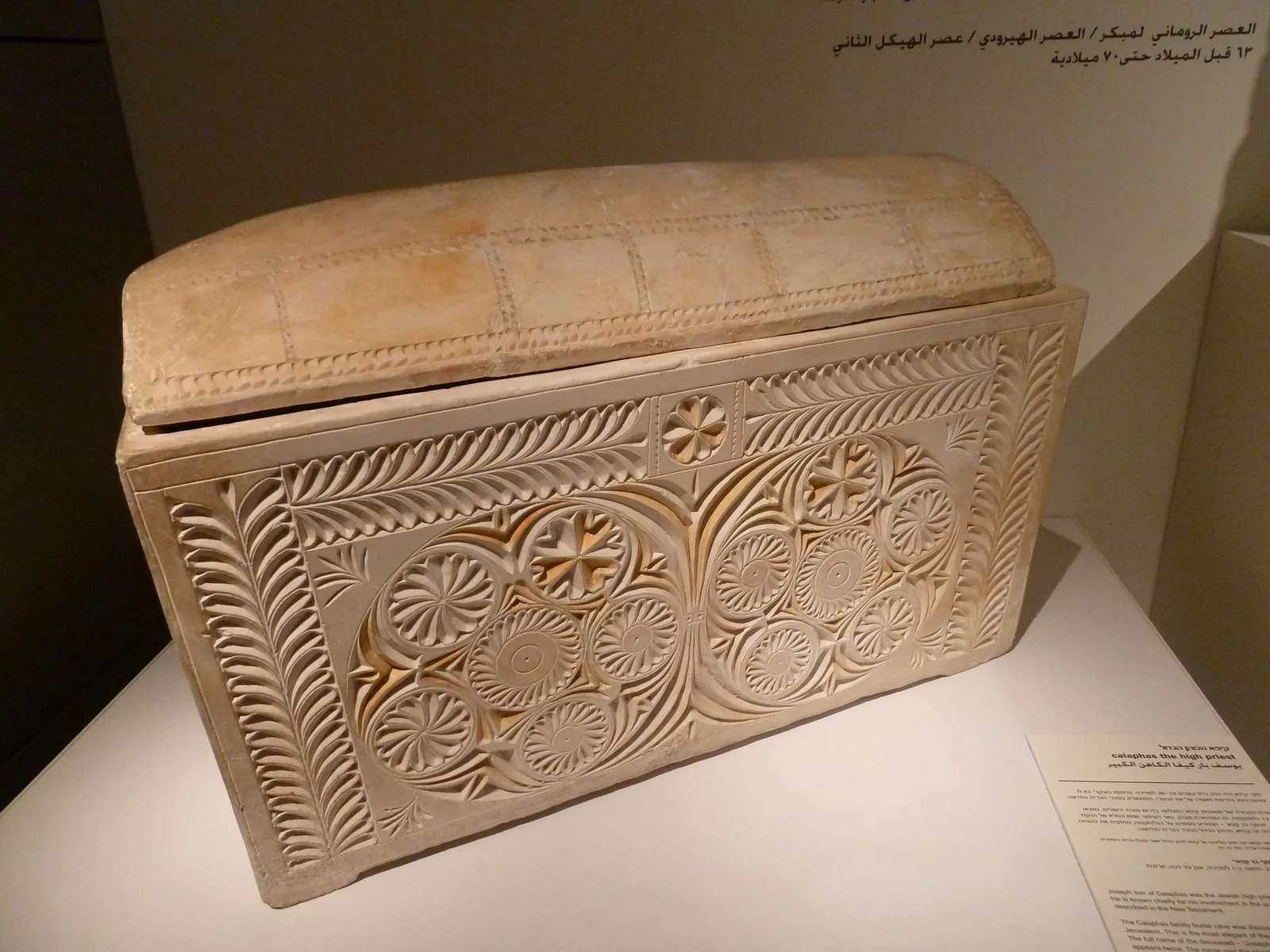
The Caiaphas ossuary (original), Israel Museum, Jerusalem. The inscribed box was found in a tomb in Jerusalem in 1990.
Photo: deror_avi, via Wikimedia Commons, CC BY-SA 3.0.

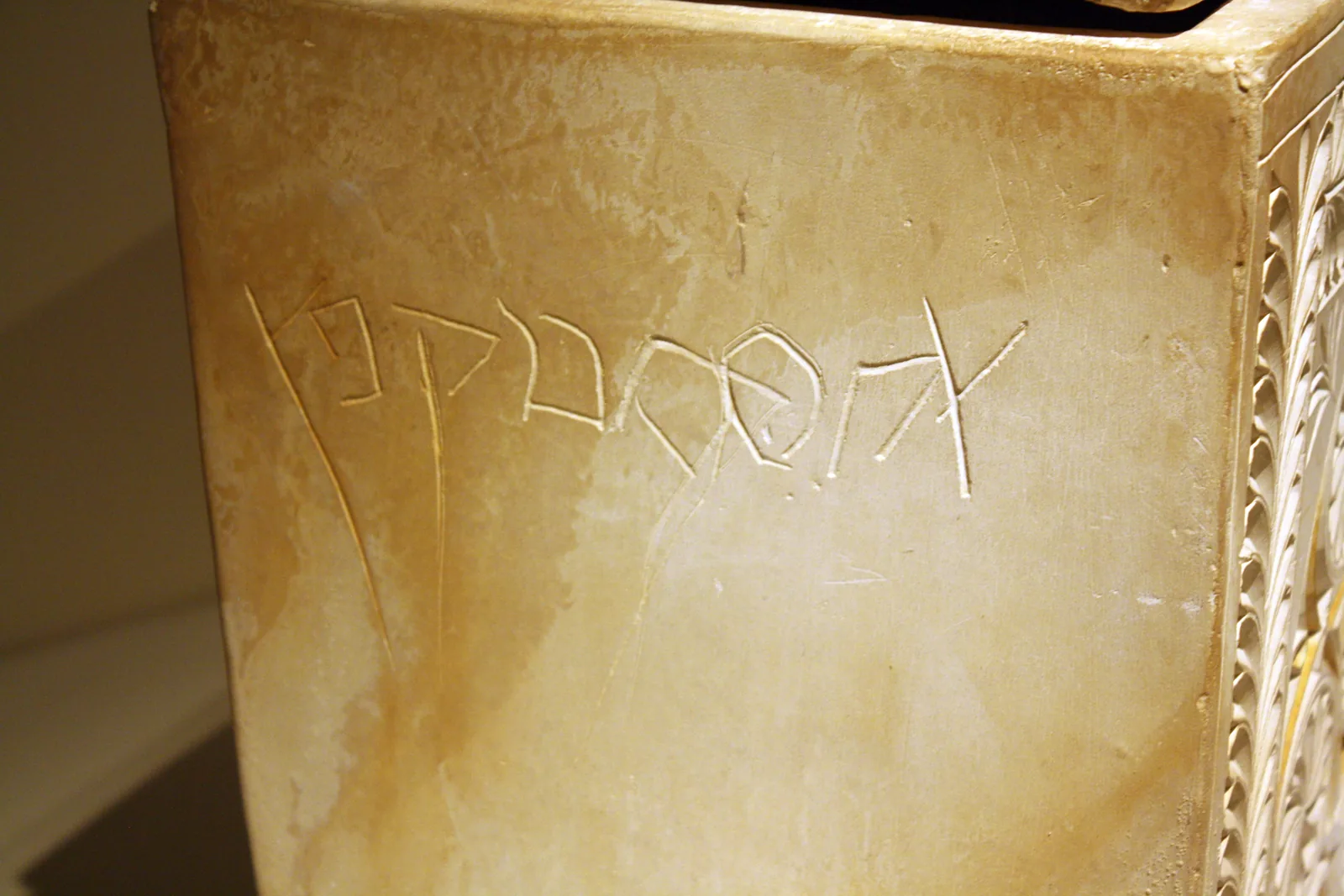
The inscription on the Caiaphas ossuary (original), Israel Museum, Jerusalem. The name of Joseph son of Caiaphas is cut into the box.
Photo: BRBurton, via Wikimedia Commons, CC0 1.0.

The story
In late 1990, workers building a water park in Jerusalem's Peace Forest, in the south of the city, broke into a rock-cut burial cave. Zvi Greenhut of the Israel Antiquities Authority excavated it. The cave had four burial niches and twelve ossuaries, limestone boxes for gathered bones. Six were intact and six broken, and the workers had moved some before the archaeologists arrived.[S6][S9][S2][S19]
The most elaborate box, decorated with rosettes, carries two Aramaic inscriptions scratched in a cursive hand. Both give the name Yehosef, Joseph, then bar, son of, and a family name written once with three letters and once with four. The Israel Museum renders it "Joseph son of Caiaphas". Inside were partial remains of six people, among them a man of about sixty. A plainer box in the cave carries the shorter spelling alone.[S2][S19][S6][S15]
The name was already known from texts. Josephus says the Roman governor Valerius Gratus made "Joseph Caiaphas" high priest, and that Vitellius later removed "Joseph, who was also called Caiaphas." The Gospels call him only Caiaphas. The Israel Museum gives his term as 18–36 CE.[S11][S12][S13][S14][S1]
The museum's text says the name and the decoration "suggest that this was indeed the ossuary of the Caiaphas from the New Testament." The epigrapher Christopher Rollston judges that the ossuary's Joseph and Josephus's Joseph Caiaphas are the same person, and Richard Bauckham's 2012 study describes the tomb as thought to belong to the high priest and his family.[S2][S19][S18]
Others are less sure. Lawrence Mykytiuk counts only two matching marks, the name and the family name, and calls the ossuary's Joseph "no more than a reasonable candidate", mainly because the box never calls him a priest. William Horbury, as Rollston reports his 1994 article, read the family name as Qopha and argued that the box and the texts name different men. An unsigned page from the Biblical Archaeology Institute argues for Kopa. In 2011 the Israel Antiquities Authority itself said the tomb had never been established beyond doubt as Caiaphas's burial place.[S7][S19][S8][S21]
A second box, confiscated from looters and published in 2011, names "Miriam daughter of Yeshua son of Caiaphas, priests of Ma'aziah from Beth 'Imri." Its editors judged the inscription authentic. It documents a priestly family of that name, but its findspot is unknown. Neither box mentions Jesus or a trial.[S16][S17][S18]
Key findings
| Finding | Sources |
|---|---|
An excavated tomb with a Caiaphas-family nameThe cave was found in late 1990 in Jerusalem's Peace Forest and excavated by the Israel Antiquities Authority. Of its twelve ossuaries, an ornate one names Yehosef bar Caiaphas twice, and a plainer one gives the family name alone. The Israel Museum holds the ornate box. | S2 S9 S6 S15 S20 S19 S7 S8 S1 |
Josephus supplies the high priest's personal nameThe Gospels say only Caiaphas. Josephus calls the high priest Joseph, also called Caiaphas, appointed by Gratus and removed by Vitellius. The ossuary's Joseph plus the family name is the match that started the identification. | S13 S14 S11 S12 S19 S16 |
The identification is likely to some, a candidate to othersThe museum, Rollston and Bauckham treat the ossuary as probably the high priest's. Mykytiuk calls Joseph a reasonable candidate only, since the box names no office. Some scholars ask whether it belonged to another Joseph of the same family. | S2 S1 S19 S18 S16 S7 S21 S15 S20 S6 S4 |
The spelling is read two waysMost readers take the family name as Qayafa, Caiaphas. Horbury, as Rollston reports him, read a waw and the name Qopha, and an unsigned institute page argues for Kopa. Sources also disagree about which spelling is on which side of the box. | S19 S7 S15 S8 S18 |
Bones, nails, a second ossuary and a house traditionThe ornate box held six people's remains, including a man of about sixty, but nothing on it says whose bones they were. A 2011 claim that nails from the tomb were used in Jesus' crucifixion was rejected by the IAA. The unprovenanced Miriam ossuary names a Caiaphas priestly family. Traditions placing Caiaphas's house on Abu Tor or Mount Zion have no direct evidence. | S6 S20 S15 S9 S21 S16 S17 S18 S19 |
Labels and sources are taken from the linked claims, so they stay in step with the ledger. How we label evidence.
Where scholars land
Conservative
Bryan Windle (Bible Archaeology Report, 2025)
Bryan Windle holds that literary and archaeological evidence has established the high priest Caiaphas as historical. He sides with the many scholars who assign the ornate ossuary to Joseph Caiaphas and judges that it likely once held his remains, while calling the idea that the tomb's nails crucified Jesus a stretch of the evidence.
Critical
Lawrence Mykytiuk (Biblical Archaeology Society, 2021)
Lawrence Mykytiuk accepts that the inscriptions are authentic and that the ossuary's time and place fit the Gospel setting. But he counts only two matching marks of identity, the personal name and the family name. Without a third, such as the title priest, the ossuary's Joseph is no more than a reasonable candidate.
Skeptical
William Horbury (Palestine Exploration Quarterly, 1994), as reported by Christopher Rollston
William Horbury, as Christopher Rollston reports his 1994 article, reads the family name with a waw, as Qopha, and draws on rabbinic evidence to argue that the ossuary's Joseph and the high priest Joseph Caiaphas were different men with similar-sounding names. An unsigned Biblical Archaeology Institute page argues the same way for Kopa.
Each column states a position in that scholar or institution's own best terms, with a named source.
Records vs. retellings
What people often say
Archaeologists found the bones of Caiaphas.
What the object or text actually says
The ornate ossuary held partial remains of six people, including a man of about sixty. Its inscriptions give only the name Yehosef bar Caiaphas (or Qopha); they name no office. A reference page on the find records that the bones were reburied on the Mount of Olives.
Where it stands
The man of sixty is the reason some writers suggest the high priest. Whose bones they were is not recorded on the box, and the identification of the ossuary itself is disputed.
Claims 6, 8, 11 ↓What people often say
The Caiaphas ossuary confirms the trial of Jesus.
What the object or text actually says
The inscriptions name a Joseph of the Caiaphas family. They do not mention Jesus, a trial or the high priesthood.
Where it stands
Caiaphas's part in the arrest and trial comes from the Gospels. Josephus records his appointment and removal as high priest. At most, the ossuary may be his burial box.
Claims 7, 11 ↓What people often say
The ossuary plainly reads "Caiaphas".
What the object or text actually says
The family name is written once with three letters and once with four. Readers differ over whether the second letter of the longer form is a yod (Qayafa, Caiaphas) or a waw (Qopha).
Where it stands
Disputed. Rollston reads yod; Horbury, as Rollston reports him, read waw; an unsigned institute page argues for Kopa.
Claims 4, 10 ↓What people often say
Nails from Caiaphas's tomb were used to crucify Jesus.
What the object or text actually says
The excavation report, as quoted by Gordon Franz, records two iron nails, one inside an ossuary and one in a burial niche, and suggests they may have been used to scratch the inscriptions.
Where it stands
Simcha Jacobovici argued for the crucifixion link in a 2011 film. The Israel Antiquities Authority said the interpretation had no basis in archaeological findings or research.
Claim 14 ↓The object
Caiaphas ossuary (ornate ossuary inscribed with the name Yehosef bar Qayafa / Qafa)
- Name
- Caiaphas ossuary (ornate ossuary inscribed with the name Yehosef bar Qayafa / Qafa)
- Provenance
- excavated
- Findspot
- Burial cave in the Peace Forest, south Jerusalem (Greenhut's 'Atiqot title calls the area North Talpiyot); found in place in kokh IV, per Franz
- Found
- 1990
- Holder
- Israel Museum, Jerusalem
- Catalog
- IAA 91-468
- Peer review
- published
- Announced by
- excavator
- Notes
- Catalog number from Hanson's reference page (S9); the Israel Museum pages opened do not show it. Size: Hanson gives about 37 cm high and 75 cm long; the museum's Google Arts & Culture record gives L 74, W 29 cm. Rollston cites the CIIP numbers 461 (this ossuary) and 463 (the plainer Qp' ossuary) from Cotton et al. 2010, pp. 481-488 (S19). Reich's BAR article (S4) was read only in its free lead. Zias's anthropological report ('Atiqot 21, 1992) and Reich's 'Atiqot inscription report are known here only through Franz's bibliography (S6).
- Primary publication
- S4
Miriam ossuary ("Miriam daughter of Yeshua son of Caiaphas, priests of Ma'aziah from Beth 'Imri")
- Name
- Miriam ossuary ("Miriam daughter of Yeshua son of Caiaphas, priests of Ma'aziah from Beth 'Imri")
- Provenance
- unprovenanced
- Findspot
- Unknown; reported to come from a burial cave in the Elah Valley area
- Found
- Acquired by the Israel Antiquities Authority about 2008 (Bauckham); published 2011
- Holder
- Israel Antiquities Authority
- Catalog
- Not given in the sources opened
- Peer review
- published
- Announced by
- independent
- Notes
- Tel Aviv University's release (S17) says the IAA confiscated it from antiquities looters. Its editors date the ossuary to 70-135 CE on its decoration and associated lamps, and the script to the late first century BCE or first century CE (S16 abstract). R1: unprovenanced, so no row about it is labeled Confirmed.
- Primary publication
- S16
Bible references
References only. Verse text is not reproduced here.
- Matthew 26:3 The chief priests and elders gather in the palace of the high priest called Caiaphas
- Matthew 26:57 Jesus is led to Caiaphas the high priest after his arrest
- Luke 3:2 Dates John the Baptist's ministry to the high priesthood of Annas and Caiaphas
- John 11:49-53 Caiaphas, high priest that year, says it is better for one man to die for the people
- John 18:13-14 Jesus is taken first to Annas, father-in-law of Caiaphas
- John 18:24 Annas sends Jesus bound to Caiaphas
- John 18:28 Jesus is led from Caiaphas to the Roman governor's headquarters
- Acts 4:6 Caiaphas is named with Annas among the high-priestly family questioning the apostles
Timeline
| Date | What happened | Sources |
|---|---|---|
| 18-36 | Joseph Caiaphas serves as high priest, appointed by Valerius Gratus and later removed by Vitellius (Josephus). The Israel Museum gives 18–36 CE; COJS gives 18 to 36/37 CE. | S11 S12 S1 S15 |
| 42-43 | Date of a coin of Agrippa I found in one of the tomb's ossuaries, as reported by Rollston; Windle gives the coin's minting as about 37–44 CE. | S19 S20 |
| 1990 | The burial cave is found during construction work in the Peace Forest, Jerusalem, and excavated by Zvi Greenhut (IAA). | S9 S6 S15 |
| 1992 | Greenhut's excavation report and Reich's inscription report appear in 'Atiqot 21, and both publish articles in Biblical Archaeology Review 18.5 (as listed by Franz and Hanson). | S6 S9 S4 |
| 1992-10-05 | The Israel Museum opens the exhibition "Ossuary of Caiaphas - The High Priest (18-36 CE)", which runs to 30 November 1993. | S1 |
| 1993 | Émile Puech publishes an article in Le Monde de la Bible that, as Bauckham reports, argues along the same lines as Horbury. | S18 |
| 1994 | William Horbury publishes "The 'Caiaphas' Ossuaries and Joseph Caiaphas" in Palestine Exploration Quarterly 126, arguing (as Rollston reports) for the reading Qopha. | S19 |
| 2010 | Rollston cites the Corpus Inscriptionum Iudaeae/Palaestinae, vol. 1, "Caiaphas Cave" inscriptions (pp. 481-488). | S19 |
| 2011 | Zissu and Goren publish the Miriam ossuary in Israel Exploration Journal 61, judging its inscription authentic. | S16 S17 |
| 2011-04-12 | Simcha Jacobovici presents his nails claim; the Israel Antiquities Authority rejects the film's interpretation. | S21 S6 |
| 2012 | Richard Bauckham's "The Caiaphas Family" appears in the Journal for the Study of the Historical Jesus. | S18 |
| 2021-11-19 | Lawrence Mykytiuk, replying in BAS Queries & Comments, calls the ossuary's Joseph "no more than a reasonable candidate". | S7 |
Competing explanations
The ossuary belonged to the high priest Joseph Caiaphas
- Case for
- The personal name Joseph and the family name both match Josephus, the setting is first-century Jerusalem, and the box is unusually ornate (S2, S15, S19). Rollston argues the two spellings parallel the Greek variants Kaiafa and Kaifa and judges the ossuary's Joseph and Josephus's Joseph Caiaphas the same person (S19).
- Case against
- Only two marks of identity match; the box names no office (S7). Horbury read a different name (S19). The IAA said in 2011 the tomb had never been established beyond doubt as Caiaphas's (S21).
- What would settle it
- An inscription in the same tomb naming the high priesthood, or a secure reading of the four-letter spelling, would narrow this.
- Sources
- S2 S15 S19 S7 S21
It belonged to another Joseph of the Caiaphas family
- Case for
- Caiaphas may be a family name or nickname rather than a father's name (S18, S20), and Franz notes the possibility of a grandfather or grandson also named Joseph (S6).
- Case against
- No source opened names a specific other Joseph; the age of the man of about sixty is consistent with the high priest, though nothing ties those bones to the inscription (S6, S20).
- What would settle it
- Further inscriptions from the family, or a fuller genealogy, would be needed.
- Sources
- S18 S20 S6
The name is Qopha or Kopa, not Caiaphas
- Case for
- Horbury read a waw in the longer spelling (as reported in S19); the Biblical Archaeology Institute argues the back inscription is clearly Kopa and points to a coin in the mouth of one of the dead as unlikely for a high priest's family (S8).
- Case against
- Rollston reads a yod and rejects Horbury's case, and the Miriam ossuary's editors read the same family name as Caiaphas (S19, S16).
- What would settle it
- A published, high-resolution epigraphic re-examination of the longer spelling would settle the letter.
- Sources
- S19 S8 S16
What would settle it
- A new, published epigraphic study of the four-letter spelling (yod or waw) would decide the Qayafa versus Qopha question.
- Any further inscription from the tomb or the family naming the high priesthood would decide the identification.
What remains unknown
- Whether the ornate ossuary's Joseph was the high priest, another family member, or a man of a different family.
- Whether the second letter of the longer spelling is a yod or a waw.
- Whose bones the man of about sixty were.
- Where the Miriam ossuary was actually found.
All 16 claims, each labelled and sourced
All 16 claims, each labelled and sourced
| Claim | Evidence | Status | Sources | Checked |
|---|---|---|---|---|
| 1.A rock-cut burial cave was found in late 1990 during construction work in Jerusalem's Peace Forest, in the south of the city, and excavated by Zvi Greenhut of the Israel Antiquities Authority. Sources give the month as November (COJS), December (Hanson) or November/December (Franz). | Confirmed | Broad consensus | S2 S9 S6 S15 S20 | 2026-11-21 |
| 2.The cave had four burial niches (kokhim) and held twelve ossuaries: six intact and fragments of six others. Two were found in place in the same niche; the workers had moved others. Rollston reports that one ossuary held a coin from the sixth year of Agrippa I (about 42–43 CE). | Confirmed | Broad consensus | S2 S6 S19 S20 | 2026-11-21 |
| 3.The ornate ossuary carries two Aramaic inscriptions in a cursive hand. Each gives the name Yehosef (Joseph) followed by bar (son of) and a family name, written once as Qp' and once with four letters, read by most as Qyp' (Qayafa). The Israel Museum renders the name "Joseph son of Caiaphas" and says it "appears twice". | Confirmed | Broad consensus | S2 S9 S19 S7 S15 | 2026-11-21 |
| 4.How to read the four-letter spelling is debated. Rollston reads the second letter as yod (Qyp', Qayafa) and explains the three- and four-letter forms as spelling variants matching the Greek manuscript variants Kaiafa and Kaifa. Horbury, as Rollston reports him, read a waw (Qwp', Qopha). Sources also disagree about which spelling is on which side: COJS puts the four-letter form on the long side, while Schnabel, quoted by Mykytiuk, puts "Qayafa" on the narrow side. | n/a | Disputed | S19 S7 S15 S8 | 2026-11-21 |
| 5.A second, plainer ossuary in the cave bears the family name alone, Qp'. Franz, quoting the anthropological report, says it held the remains of five individuals and no adult male bones. | Consistent | Broad consensus | S19 S15 S6 S20 | 2026-11-21 |
| 6.The ornate ossuary held the partial remains of six individuals, including a man of about sixty, according to the anthropological report as quoted by Franz and summarized by Windle and COJS. Nothing on the box identifies whose bones they were. Hanson's reference page records that the bones were reburied on the Mount of Olives. | Consistent | Broad consensus | S6 S20 S15 S9 | 2026-11-21 |
| 7.Josephus names the high priest as Joseph who was also Caiaphas (Ἰώσηπος ὁ καὶ Καϊάφας, Antiquities 18.35) and the high priest Joseph surnamed Caiaphas (18.95). In Whiston's translation, Valerius Gratus made "Joseph Caiaphas" high priest, and Vitellius later removed "Joseph, who was also called Caiaphas". The Gospels use only the name Caiaphas. | Confirmed | Broad consensus | S13 S14 S11 S12 S19 S16 | 2026-11-21 |
| 8.Whether the ornate ossuary belonged to Joseph Caiaphas, the high priest of the Gospels, is debated. The Israel Museum says the name and decoration "suggest that this was indeed" his ossuary; Rollston judges them the same person; Bauckham describes the tomb as thought to be the high priest's family tomb; Zissu and Goren treat the find as archaeological documentation of the family. Mykytiuk calls Joseph "no more than a reasonable candidate", Horbury (as Rollston reports him) argued for a different man, and the Israel Antiquities Authority said in 2011 that the tomb had never been established beyond doubt as Caiaphas's burial place. | Consistent | Disputed | S2 S1 S19 S18 S16 S7 S21 S15 S20 Against: S7 S19 S8 S21 | 2026-11-21 |
| 9.Some scholars allow that the ossuary may belong to another member of the family rather than the high priest himself. Franz notes a continuing debate over whether it was the high priest's or his grandfather's or grandson's, either of whom could also have been named Joseph. Reich, quoted by Windle, says Caiaphas may be a family nickname, so the inscription may mean Joseph of the Caiaphas family; Bauckham argues that bar Qayafa is a family name rather than a true patronymic. | n/a | Disputed | S6 S20 S18 S4 | 2026-11-21 |
| 10.A reading of the family name as Qopha or Kopa, not Caiaphas, with the ossuary's Joseph a different man. Horbury argued this (as Rollston reports him), and Bauckham notes that Émile Puech argued similarly in 1993. The Biblical Archaeology Institute's page, unsigned and not peer-reviewed, calls the Caiaphas attribution almost certainly mistaken. Rollston rejects Horbury's reading. | n/a | Disputed | S19 S18 S8 Against: S19 | 2026-11-21 |
| 11.The inscriptions give only a personal name and family name. They do not call Joseph a priest or high priest, and they do not mention Jesus or a trial. Mykytiuk writes: "The main problem is that the ossuary makes no mention of him being a priest at all, let alone the high priest." The trial of Jesus before Caiaphas is recorded in the Gospels. | Confirmed | Broad consensus | S2 S7 S19 | 2026-11-21 |
| 12.The ossuary comes from a controlled excavation by the Israel Antiquities Authority, and no source consulted for this entry questions that the object and its inscriptions are ancient. Mykytiuk refers to "the authenticity of the inscriptions"; the critics dispute the reading and the identification, not the object. | Confirmed | Broad consensus | S2 S9 S7 S19 S8 | 2026-11-21 |
| 13.The ossuary is held by the Israel Museum, Jerusalem (Hanson gives the inventory number IAA 91-468). The museum showed it in the exhibition "Ossuary of Caiaphas - The High Priest (18-36 CE)" from 5 October 1992 to 30 November 1993, and in "Cradle of Christianity" (2000–2001). | Confirmed | Broad consensus | S1 S2 S9 S8 | 2026-11-21 |
| 14.In 2011 the filmmaker Simcha Jacobovici argued that two iron nails from the tomb were used in the crucifixion of Jesus, while saying he did not know this for certain. Franz cites the excavation report suggesting the nails were used to scratch the inscriptions, and the Israel Antiquities Authority said the film's interpretation "has no basis in archaeological findings or research". | No direct evidence | Disputed | S6 S21 S20 Against: S6 S21 | 2026-11-21 |
| 15.A separate, unprovenanced ossuary, acquired by the Israel Antiquities Authority and published in 2011 by Boaz Zissu and Yuval Goren, reads "Miriam daughter of Yeshua son of Caiaphas, priests of Ma'aziah from Beth 'Imri". Patina tests led its editors to judge the inscription authentic, and Rollston does not doubt it. It is reported to come from the Elah Valley area, but its findspot is not secure. It points to a Caiaphas priestly family of the Ma'aziah course; it does not name the high priest. | Consistent | Majority view | S16 S17 S18 S19 Against: S8 | 2026-11-21 |
| 16.Tradition has placed Caiaphas's house in several places: on Abu Tor, the "Hill of Evil Counsel" near the tomb (COJS), and at Gallicantu on the eastern slope of Mount Zion or the Monastery of Saint Savior on Mount Zion (Windle). Windle concludes that it is not known precisely where Caiaphas lived. | No direct evidence | Tradition only | S15 S20 | 2026-11-21 |
Evidence: what the object, inscription or text supports. A Documented record tag marks a purchase, edition, test, retraction or disclosure. Status: how far specialists agree. How we label evidence.
Sources
- S1The Israel Museum, Jerusalem, “Ossuary of Caiaphas - The High Priest (18-36 CE) (exhibition page, October 5 1992 - November 30 1993)”, The Israel Museum, Jerusalem, undated web page.museum recordTier 1neutral Link · accessed 2026-11-21
Note: Exhibition page, not an object record. One sentence of description: a family burial cave in southern Jerusalem with the name Joseph bar Caiaphas, who played a role in the interrogation and trial of Jesus. - S2The Israel Museum, Jerusalem (curator listed: David Mevorah), “Elaborate ossuary of "Joseph son of Caiaphas"”, Google Arts & Culture (Israel Museum collection; rights: Israel Antiquities Authority), undated web page.museum recordTier 1neutral Link · accessed 2026-11-21
Note: Gives: most elegant of the 12 ossuaries; the full name appears twice; the name and decoration suggest it was the ossuary of the New Testament Caiaphas; Herodian period; location Talpiot; L 74, W 29 cm; exhibited in Cradle of Christianity, 2000-2001. - S4Ronny Reich, “Caiaphas Name Inscribed on Bone Boxes”, Biblical Archaeology Review 18.5 (September/October 1992), 1992-09.secondaryTier 2neutral Link · accessed 2026-11-21
Note: Only the free lead of the page is visible (paywalled). The lead presents the name as that of the high priest or a member of his family. Not quoted here; Reich's nickname remark is cited through Windle's quotation (S20). - S6Gordon Franz, “Simcha Jacobovici and the Nails From Caiaphas' Tomb”, Associates for Biblical Research, 2011-04-14.advocacyTier 3conservative Link · accessed 2026-11-21
Note: Summarizes and quotes the 'Atiqot 21 reports by Greenhut, Reich and Zias, which were not consulted for this entry. - S7Lawrence Mykytiuk (reply to a letter by Avram Israel Reisner), “More Queries & Comments, Winter 2021 ("Biblical Figures Confirmed")”, Biblical Archaeology Society, 2021-11-19.secondaryTier 2critical Link · accessed 2026-11-21
Note: Mykytiuk quotes Eckhard Schnabel, Jesus in Jerusalem (Eerdmans 2018), for the inscription readings; Schnabel's book is cited from later reports. Mykytiuk's BAR Summer 2021 article page was also opened but its free part does not discuss Caiaphas, so it is not cited. - S8The Biblical Archaeology Institute (no individual author named), “The ossuary of Yohasef Bar Kopa (Yohasef, son of Kopa) - attributed by some scholars to the High Priest Caiaphas”, The Biblical Archaeology Institute (ossuary-bai.org), undated web page (site footer © 2023).advocacyTier 3skeptical Link · accessed 2026-11-21
Note: Not peer-reviewed; no author or date. Its Greek for Antiquities 18.35 does not match the Niese text on Perseus (S13), so it is not used for Josephus. - S9K. C. Hanson, “Caiaphas Ossuary”, K. C. Hanson's Collection of West Semitic Documents, last modified 2010-07-19.secondaryTier 3neutral Link · accessed 2026-11-21
Note: Gives place and date of discovery, excavator, inventory number IAA 91-468, approximate size, reburial of the bones, and a bibliography. - S11Flavius Josephus (tr. William Whiston), “Antiquities of the Jews 18.2.2 (Whiston numbering; modern 18.33-35)”, Perseus Digital Library (Tufts University), 1st century CE; Whiston translation, 1895 edition.ancient textTier 1neutral Link · accessed 2026-11-21
- S12Flavius Josephus (tr. William Whiston), “Antiquities of the Jews 18.4.3 (Whiston numbering; modern 18.90-95)”, Perseus Digital Library (Tufts University), 1st century CE; Whiston translation, 1895 edition.ancient textTier 1neutral Link · accessed 2026-11-21
- S13Flavius Josephus (ed. Benedikt Niese), “Antiquitates Judaicae 18.35 (Greek text)”, Perseus Digital Library (Tufts University); Niese, Flavii Iosephi opera (Weidmann, 1892), 1st century CE; edition 1892.edition/translationTier 1neutral Link · accessed 2026-11-21
- S14Flavius Josephus (ed. Benedikt Niese), “Antiquitates Judaicae 18.95 (Greek text)”, Perseus Digital Library (Tufts University); Niese, Flavii Iosephi opera (Weidmann, 1892), 1st century CE; edition 1892.edition/translationTier 1neutral Link · accessed 2026-11-21
- S15Center for Online Judaic Studies, “Ossuary of the High Priest Caiaphas, 18-36 CE”, Center for Online Judaic Studies (COJS), undated web page.institutionalTier 2neutral Link · accessed 2026-11-21
Note: Says the identification is not certain but that the name and period fit. Its opening line describes two burial caves with twelve loculi and four ossuaries, which conflicts with its own later text and with S2, S6 and S19 (one cave, four kokhim, twelve ossuaries); this entry follows the majority. - S16Boaz Zissu and Yuval Goren, “The Ossuary of Miriam Daughter of Yeshua Son of Caiaphas, Priests [of] Ma'aziah from Beth 'Imri”, Israel Exploration Journal 61.1 (2011), pp. 74-95 (offprint hosted by Bar-Ilan University), 2011.peer-reviewedTier 1neutral Link · accessed 2026-11-21
Note: PDF downloaded and its text layer extracted; abstract and pp. 74-79 read. Diacritics in names are simplified to plain apostrophes in this entry. - S17American Friends of Tel Aviv University, “2,000-year-old burial box could reveal location of the family of Caiaphas”, EurekAlert! (AAAS), 2011-08-29.institutionalTier 2neutral Link · accessed 2026-11-21
Note: University press release about S16, so not independent of it. - S18Richard Bauckham, “The Caiaphas Family”, Journal for the Study of the Historical Jesus 10.1 (2012), pp. 3-31, 2012.peer-reviewedTier 1neutral Link · accessed 2026-11-21
Note: Abstract and reference notes read on the Brill page; full text paywalled. The note on Puech (Le Monde de la Bible 80, 1993) says Bauckham had not seen that article and reports it through Horbury. - S19Christopher A. Rollston, “The Ossuary of Mariam Daughter of Yeshua' in Context: Limning the Broad Tableau of the Epigraphic and Literary Data”, Rollston Epigraphy (blog), 2011-07-06.secondaryTier 3critical Link · Archive · accessed 2026-11-23
Note: A named epigrapher's blog, so tier 3 under the plan's rule. Gives readings of CIIP 461, 462 and 463, reports Horbury's reading, and argues against it. - S20Bryan Windle, “Caiaphas: An Archaeological Biography”, Bible Archaeology Report, 2025-04-17.advocacyTier 3conservative Link · accessed 2026-11-21
- S21Ari Rabinovitch (Reuters), “Nails from Jesus' cross? Experts doubt it”, NBC News (Reuters), 2011-04-12.secondaryTier 2neutral Link · accessed 2026-11-21
Note: Reports Jacobovici's claim and the Israel Antiquities Authority's statement on the film.
Tier 1 is a primary record: a museum record, excavation report, edition or peer-reviewed paper. Tier 3 sources are cited as the views of those organizations. How we label evidence.
Evidence log
- Tomb found in the Peace Forest and excavated by Greenhut (S9, S6).
- Excavation, inscription and skeletal reports appear in 'Atiqot 21; Reich and Greenhut publish in BAR (as listed in S6, S9).
- Horbury argues for the reading Qopha and a different man (as reported in S19).
- Jacobovici's nails claim; the IAA rejects the interpretation and says the tomb was never established beyond doubt as Caiaphas's (S21, S6).
- The Miriam ossuary is published as authentic, naming a Caiaphas priestly family (S16, S17); Rollston rejects Horbury's reading (S19).
- Bauckham reads bar Qayafa as a family name (S18).
- Mykytiuk calls the ossuary's Joseph a reasonable candidate only (S7).
- Entry first written.
- Scripture policy: rewrote dek and verdict so the box's silence on Jesus does not undercut the Gospel trial account.
- update Sources list tightened: each claim now cites only sources we opened and checked, and a few sentences we couldn't check were removed.
Read next
The Pilate stone (Caesarea, 1961)
The other official in the Gospel trial narratives named on an object; there the identification is secure.
Josephus on Jesus (Antiquities 18.63–64 and 20.200)
Josephus is the literary source for Caiaphas's personal name and term of office.
Tacitus, Annals 15.44 (Christus and Pilate)
A non-Christian text tied to the execution of Jesus, for comparison with what an object can and cannot show.