Jesus in the evidence
Tacitus, Annals 15.44 (Christus and Pilate)
Writing in the early second century, Tacitus says that Christus was executed under Tiberius by Pontius Pilate. Most scholars accept the sentence as his. That execution is the one the Gospels record.
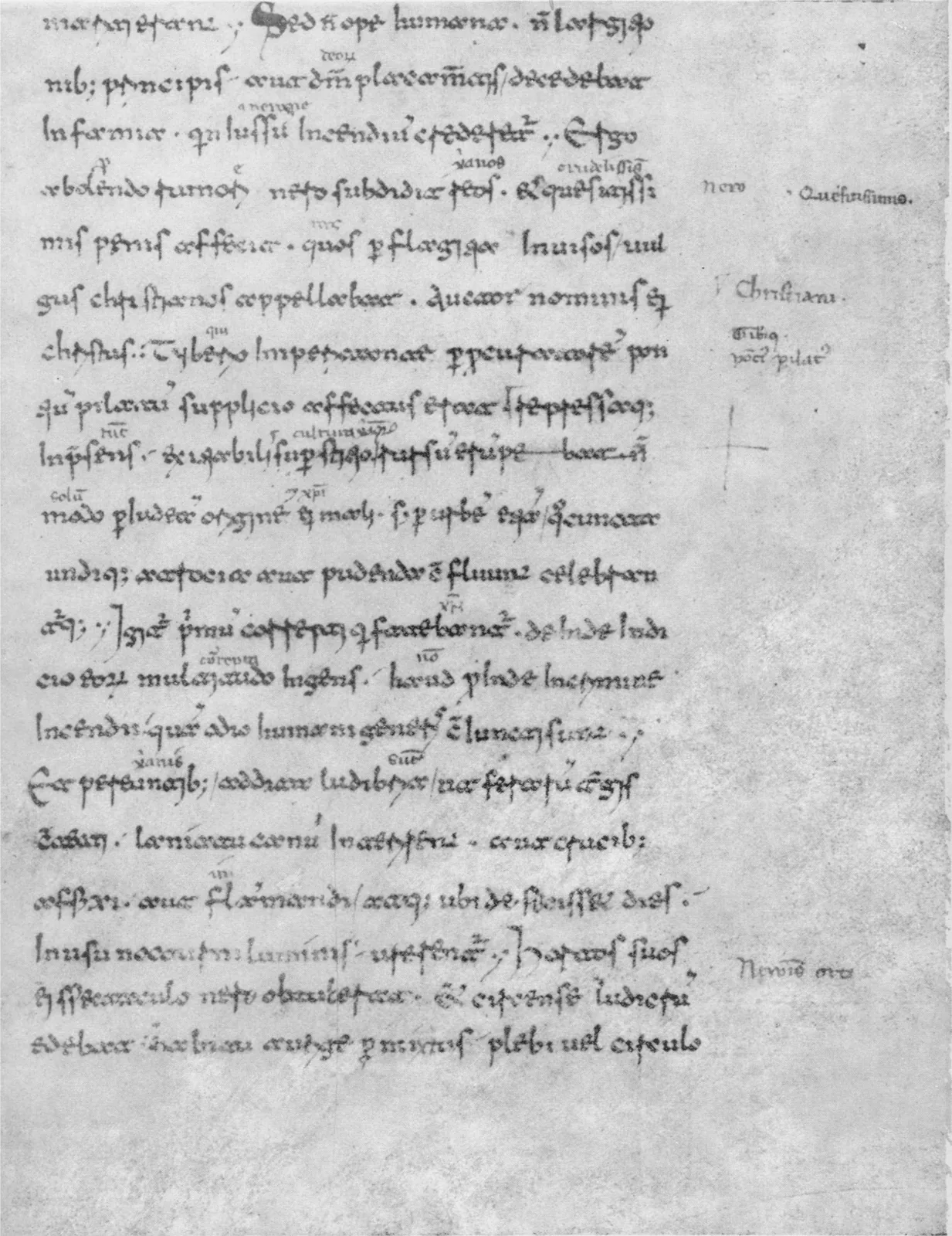
A 1902 photographic facsimile of Codex Laurentianus Mediceus 68 II, folio 38r, which carries Tacitus, Annals 15.44. The manuscript is held by the Biblioteca Medicea Laurenziana, Florence. This is a facsimile of the eleventh-century copy, not the lost first-century autograph.
Photographic facsimile by Henricus Rostagno, 1902. Public domain, via Wikimedia Commons.

The story
Tacitus, a Roman senator and historian, wrote the Annals as his last work. Lawrence Mykytiuk dates it to c. 116–117 CE; the Dickinson College commentary by Mathew Owen and Ingo Gildenhard says it was published around AD 118. In Book 15 Tacitus describes the great fire of Rome in 64 CE and the belief that Nero had ordered it.[S11][S10][S2][S4]
To get rid of the rumor, Tacitus says, Nero "fastened the guilt and inflicted the most exquisite tortures on a class hated for their abominations, called Christians by the populace." He then explains the name: "Christus, from whom the name had its origin, suffered the extreme penalty during the reign of Tiberius at the hands of one of our procurators, Pontius Pilatus." Tacitus calls the founder Christus. He does not use the name Jesus, and he says nothing about a resurrection.[S2][S8][S1]
Most scholars accept the passage as Tacitus's own. Robert Van Voorst, as quoted by Peter Kirby, concludes "with the vast majority of scholars that this passage is fundamentally sound," pointing to its Tacitean style and its hostility to Christians. Brent Shaw, who doubts the persecution story, still calls the passage "probably genuine Tacitus."[S13][S11][S4]
Two details need care. In the oldest manuscript, an eleventh-century copy now in Florence, the original hand wrote Chrestianos, later corrected to Christianos. Printed texts differ: the Latin Library prints Chrestianos, Fisher's 1906 Oxford text Christianos. The Owen and Gildenhard commentary says Chrestianos now seems to be the consensus reading. And Tacitus calls Pilate procurator, while the Pilate stone, cut in Pilate's own time, calls him prefect; the commentary calls Tacitus's term an anachronism.[S12][S11][S1][S8][S9][S14][S15]
What the passage can support is debated. Mykytiuk argues that it "clearly corroborates the New Testament on certain historical details" of Jesus' death, and suggests Tacitus may have checked Roman records. Tacitus names no source, though. Kirby sets out why Tacitus might simply have repeated what Christians said, and the classicist Peter Gainsford answers "probably not" when he asks whether the passage is independent evidence about the historical Jesus. Shaw argues that the account reflects ideas of Tacitus's own day rather than the 60s; Christopher Jones replies that there are no grounds for doubting Tacitus's report of the persecution.[S11][S13][S12][S4][S5][S6]
Key findings
| Finding | Sources |
|---|---|
The text names Christus, Tiberius and PilateAnnals 15.44 says the Christians took their name from Christus, who "suffered the extreme penalty during the reign of Tiberius at the hands of one of our procurators, Pontius Pilatus." The Latin is Christus, never Jesus. | S2 S1 S8 S9 |
Most scholars take it as Tacitus's ownVan Voorst (as quoted by Kirby) speaks of the vast majority of scholars; even Shaw, a skeptic about the persecution, calls the passage probably genuine. | S13 S11 S4 S12 S5 |
Two wording problems: Chrestianos and procuratorThe oldest manuscript first read Chrestianos, and the commentary by Owen and Gildenhard calls that reading now the consensus. Tacitus calls Pilate procurator; the contemporary Pilate stone says prefect. | S9 S11 S12 S1 S8 S15 S14 S2 |
His source is unknownTacitus names no source. Mykytiuk suggests Roman records; Kirby and Gainsford leave open that he repeated what Christians said. Whether the passage is independent corroboration turns on that question. | S11 S12 S13 S9 S14 S15 |
It records the execution; it does not mention the resurrectionThe passage reports an execution under Pilate, as the Gospels also record, and calls the movement a superstition. It does not mention a resurrection or miracles. Whether Nero's punishment of Christians after the fire happened as told is itself argued (Shaw vs. Jones). | S2 S8 S9 S4 S5 S6 |
Labels and sources are taken from the linked claims, so they stay in step with the ledger. How we label evidence.
Where scholars land
Conservative
Lawrence Mykytiuk (Biblical Archaeology Review, 2015)
Lawrence Mykytiuk argues that the passage is authentic, written in true Tacitean Latin, and that it clearly corroborates the New Testament on Jesus' execution under Pilate in Tiberius's reign. He treats procurator as an anachronism rather than an error, and suggests that Tacitus, a senator and priest, likely had access to Roman records.
Critical
Christopher P. Jones (New Testament Studies, 2017)
Christopher P. Jones, replying to Brent Shaw, argues that there are no grounds for doubting Tacitus' report of the Neronian persecution. As Shaw summarizes him, Jones holds that knowledge of Christians under that name could have reached Rome by the mid-60s and that the Tacitean account is generally credible.
Skeptical
Brent D. Shaw (Journal of Roman Studies, 2015)
Brent D. Shaw accepts the passage as probably genuine but argues it reflects ideas of Tacitus' own time, not a persecution in the 60s.
Each column states a position in that scholar or institution's own best terms, with a named source.
Records vs. retellings
What people often say
Tacitus confirms the resurrection.
What the object or text actually says
Tacitus says Christus "suffered the extreme penalty" under Tiberius at the hands of Pontius Pilatus, and calls the movement "a most mischievous superstition." He says nothing about a resurrection or miracles.
Where it stands
The passage bears on an execution under Pilate only. The resurrection is a separate question (planned entry).
Claims 3, 11 ↓What people often say
Tacitus mentions Jesus by name.
What the object or text actually says
The Latin has Christus (auctor nominis eius Christus). The name Jesus does not appear.
Where it stands
Translations and popular summaries often write Jesus. Van Voorst, as quoted by Kirby, explains that Christus fits Tacitus's point about the origin of the Christians' name.
Claim 3 ↓What people often say
Tacitus took this from official Roman archives.
What the object or text actually says
Tacitus does not name a source.
Where it stands
Unknown. Mykytiuk suggests Roman records; Kirby sets out the case that Tacitus repeated what Christians said; Gainsford answers "we don't really know".
Claims 6–7 ↓What people often say
The Tacitus passage is a Christian forgery.
What the object or text actually says
The passage survives in an eleventh-century manuscript and is hostile to Christians.
Where it stands
A minority view. Van Voorst (quoted by Kirby and Mykytiuk) and even Shaw treat the passage as Tacitus's own.
Claim 4 ↓The object
Tacitus, Annals 15.44, in the Second Medicean manuscript
- Name
- Tacitus, Annals 15.44, in the Second Medicean manuscript
- Provenance
- museum-documented
- Findspot
- Library manuscript, not an excavated object: Biblioteca Medicea Laurenziana, Florence
- Found
- Eleventh-century copy
- Holder
- Biblioteca Medicea Laurenziana, Florence
- Catalog
- Plut. 68.2, fol. 38r
- Peer review
- published
- Announced by
- independent
- Notes
- Shelfmark and folio from Gainsford (S12), who links the library's digitized image; that image link did not connect from this machine, so the manuscript itself was not viewed. The eleventh-century date and 'almost certainly the source of all other surviving manuscripts' are from Van Voorst as quoted by Mykytiuk (S11). The provenance value 'museum-documented' stands for a library-held manuscript with a known shelfmark; announced_by is set to 'independent' because the field was designed for excavated objects and does not fit an ancient text transmitted in libraries.
- Primary publication
- S8 S1
Bible references
References only. Verse text is not reproduced here.
- Luke 3:1 Dates John the Baptist's ministry by Tiberius's reign and Pilate's governorship of Judea
- Matthew 27:2 Jesus is handed over to Pilate, called the governor
- John 19:16 Pilate hands Jesus over to be crucified
- Acts 11:26 Says the disciples were first called Christians at Antioch; the Owen and Gildenhard commentary cites it on the name
- 1 Peter 4:16 Speaks of suffering as a Christian, the name Tacitus says the crowd used
Timeline
| Date | What happened | Sources |
|---|---|---|
| 26-36 | Pilate governs Judea, per the Israel Museum record of the Pilate stone. The Owen and Gildenhard commentary gives AD 27-37. | S14 S9 |
| 64 | The great fire of Rome (July 64, per Shaw). Tacitus says Nero blamed and punished the Christians. | S4 S2 |
| 116-118 | Tacitus writes the Annals: c. 116–117 per Mykytiuk; published around AD 118 per Owen and Gildenhard. | S11 S10 |
| 1000-1099 | The Second Medicean manuscript, the oldest surviving copy of this part of the Annals, is written; its original hand reads Chrestianos (per Van Voorst as quoted by Mykytiuk, and Gainsford). | S11 S12 |
| 1906 | Charles Dennis Fisher's Oxford (Clarendon Press) text of the Annales, printing Christianos. | S8 |
| 2015-08-14 | Brent D. Shaw's 'The Myth of the Neronian Persecution' appears online (Journal of Roman Studies 105, 2015). | S4 |
| 2016-12-14 | Christopher P. Jones's reply to Shaw appears online (New Testament Studies 63, 2017). | S5 |
| 2018-03-08 | Shaw's response to Jones appears online (New Testament Studies 64, 2018). | S6 |
| 2023-03-30 | Peter Gainsford publishes his account of the Chrestianos/Christianos correction in the manuscript. | S12 |
Competing explanations
Tacitus wrote the sentence, drawing on Roman records
- Case for
- Mykytiuk argues the passage is in true Tacitean Latin and that Tacitus, as proconsul of Asia, senator and member of the priestly college that supervised foreign cults, likely had access to some archives (S11).
- Case against
- Tacitus names no source, and no opened source points to a specific record (S11, S12, S13).
- What would settle it
- A named source in Tacitus's own work, or an independent Roman record of the execution, would settle it; neither is known.
- Sources
- S11 S12 S13
Tacitus wrote the sentence, repeating what Christians or common report said
- Case for
- Kirby sets out six grounds, including the missing source, the anachronistic procurator and the use of Christus rather than Jesus (S13). Shaw argues the passage reflects ideas current when Tacitus wrote (S4). Gainsford doubts that it is independent evidence (S12).
- Case against
- Kirby also gives replies to each ground, and Mykytiuk calls the Christian-informants assumption opinion rather than evidence (S13, S11).
- What would settle it
- The same as above: an identified source for Tacitus's information.
- Sources
- S13 S4 S12 S11
What would settle it
- Viewing fol. 38r of Laurentian Plut. 68.2 directly (the library's digitized image did not load for this entry), or a critical edition's apparatus, would let the Chrestianos row cite the manuscript and an edition rather than reports of them.
- Reading Van Voorst, Jesus Outside the New Testament (2000), directly would let the authenticity row cite him rather than quotations of him on Kirby's and Mykytiuk's pages.
- Reading the full texts of Shaw (2015, 2018) and Jones (2017), not only their abstracts, would firm up the persecution row.
- An identified source for Tacitus's information would settle the archives vs. Christian-informants rows; none is known.
What remains unknown
- Where Tacitus got his information about Christus.
- Whether Tacitus wrote Chrestianos (now the majority reading) and, if so, what he meant by contrasting it with Christus.
- Whether Nero's punishment of Christians after the fire happened as Tacitus describes.
- The exact year the Annals were written or published.
All 11 claims, each labelled and sourced
All 11 claims, each labelled and sourced
| Claim | Evidence | Status | Sources | Checked |
|---|---|---|---|---|
| 1.Tacitus wrote the Annals, his last major work, early in the second century CE. Mykytiuk dates it c. 116–117 CE; Owen and Gildenhard say it was published around AD 118. The exact year is not settled. | n/a | Broad consensus | S11 S10 | 2026-11-21 |
| 2.Annals 15.44 says that, to get rid of the rumor that he had ordered the fire, Nero "fastened the guilt and inflicted the most exquisite tortures on a class hated for their abominations, called Christians by the populace" (Church and Brodribb). The Latin word for that group is printed as Chrestianos in one opened text and Christianos in another. | Confirmed | Broad consensus | S2 S1 S8 S9 | 2026-11-21 |
| 3.The passage says: "Christus, from whom the name had its origin, suffered the extreme penalty during the reign of Tiberius at the hands of one of our procurators, Pontius Pilatus" (Latin: auctor nominis eius Christus Tiberio imperitante per procuratorem Pontium Pilatum supplicio adfectus erat). Tacitus says Christus; the name Jesus does not appear. | Confirmed | Broad consensus | S2 S8 S1 S9 | 2026-11-21 |
| 4.Most scholars accept the passage, including the Christus sentence, as written by Tacitus. Van Voorst, as quoted by Kirby, concludes "with the vast majority of scholars that this passage is fundamentally sound"; Mykytiuk cites its "true Tacitean Latin"; Shaw calls it "probably genuine Tacitus"; Gainsford answers "yes" to whether Tacitus wrote it. | n/a | Broad consensus | S13 S11 S4 S12 S5 | 2026-11-21 |
| 5.In the oldest manuscript (the Second Medicean, eleventh century) the original reading is Chrestianos, later altered to Christianos. Van Voorst, quoted by Mykytiuk, says a marginal gloss corrects it and that Chrestianos is adopted by the three current critical editions; Gainsford says someone scraped away most of the e. The Owen and Gildenhard commentary says Chrestianos now seems to be the consensus. Printed texts still differ: the Latin Library has Chrestianos, Fisher (1906) Christianos. | n/a | Majority view | S9 S11 S12 S1 S8 | 2026-11-21 |
| 6.Tacitus took his information about Christus from Roman archives or official records. Tacitus does not name a source. Mykytiuk suggests he "likely had access to some archives" as proconsul, senator and priest; Gainsford answers "we don't really know" where Tacitus got his information. | No direct evidence | Disputed | S11 S12 S13 | 2026-11-21 |
| 7.Tacitus may report what Christians themselves said about their origin rather than an independent record. Kirby sets out six grounds for this view (no named source, the anachronistic title, the use of Christus, and others) and also the replies to them; Mykytiuk calls one analysis that assumes Christian informants only "based on opinion, not evidence"; Gainsford argues from the spellings that Tacitus relied on at least two written sources. | n/a | Disputed | S13 S11 S12 | 2026-11-21 |
| 8.Pilate's title was procurator, as Annals 15.44 says (per procuratorem; "one of our procurators"). The Pilate stone, cut during his term, restores his title as [praef]ectus Iudae[a]e, prefect of Judea. The Owen and Gildenhard commentary calls procurator an anachronism, citing Brunt, and Mykytiuk agrees it is an anachronism rather than a simple error. | Contradicted | Broad consensus | S15 S14 S2 S9 S11 | 2026-11-21 |
| 9.Nero punished Christians in Rome as scapegoats for the fire of 64, as Tacitus tells it. Shaw (2015) contests the general execution personally ordered by Nero and argues that the passage reflects ideas current when Tacitus was writing, not the realities of the 60s; Jones (2017) replies that there are no grounds for doubting Tacitus' report; Shaw (2018) restates that such a persecution "seems improbable". The Owen and Gildenhard commentary notes that Suetonius records Nero punishing Christians without linking it to the fire. | n/a | Disputed | S4 S5 S6 S9 | 2026-11-21 |
| 10.Annals 15.44 is a non-Christian Roman witness that the founder of the Christian movement was executed under Pilate in the reign of Tiberius. The Owen and Gildenhard commentary calls it the earliest reference in pagan literature to the execution of Christ by order of Pilate, and Mykytiuk says it "clearly corroborates the New Testament on certain historical details". The Pilate stone places Pilate in office in Judea under Tiberius. Whether the passage is independent of Christian telling is debated: Gainsford answers "probably not", and Kirby sets out the case for Christian informants. | Consistent | Majority view | S9 S11 S14 S15 Against: S12 S13 | 2026-11-21 |
| 11.The passage says nothing about a resurrection, miracles or the teaching of Christus. It reports his execution and calls the movement "a most mischievous superstition" (Latin exitiabilis superstitio). The resurrection is recorded in the Gospels and in 1 Corinthians 15. | Confirmed | Broad consensus | S2 S8 S9 | 2026-11-21 |
Evidence: what the object, inscription or text supports. A Documented record tag marks a purchase, edition, test, retraction or disclosure. Status: how far specialists agree. How we label evidence.
Sources
- S1Tacitus (Latin text, The Latin Library), “Annales, Liber XV (chapter 44)”, The Latin Library, c. early 2nd century CE; undated web text.ancient textTier 1neutral Link · accessed 2026-11-21
Note: Prints Chrestianos. The page does not name its base edition and has small typing errors in this chapter (Tibero for Tiberio, exitiablilis); Latin is quoted in this entry from S8. - S2Tacitus (tr. Alfred John Church and William Jackson Brodribb), “Annals 15.44”, Perseus Digital Library (Tufts University); Complete Works of Tacitus, Random House, reprinted 1942, c. early 2nd century CE; translation reprinted 1942.edition/translationTier 1neutral Link · accessed 2026-11-21
- S4Brent D. Shaw, “The Myth of the Neronian Persecution”, The Journal of Roman Studies 105 (2015), pp. 73-100 (Cambridge University Press), 2015-11 (online 2015-08-14).peer-reviewedTier 1skeptical Link · accessed 2026-11-21
Note: Abstract and citation metadata read on the publisher's page; full text cited from later reports. - S5Christopher P. Jones, “The Historicity of the Neronian Persecution: A Response to Brent Shaw”, New Testament Studies 63.1 (2017), pp. 146-152 (Cambridge University Press), 2017-01 (online 2016-12-14).peer-reviewedTier 1critical Link · accessed 2026-11-21
Note: Abstract and citation metadata read on the publisher's page; full text cited from later reports. - S6Brent D. Shaw, “Response to Christopher Jones: The Historicity of the Neronian Persecution”, New Testament Studies 64.2 (2018), pp. 231-242 (Cambridge University Press), 2018-04 (online 2018-03-08).peer-reviewedTier 1skeptical Link · accessed 2026-11-21
Note: Abstract and citation metadata read on the publisher's page (the plan had Crossref metadata only); full text cited from later reports. - S8Tacitus (ed. Charles Dennis Fisher), “Annales ab excessu divi Augusti, 15.44”, Clarendon Press, Oxford, 1906; Perseus Digital Library (Tufts University), c. early 2nd century CE; edition 1906.edition/translationTier 1neutral Link · accessed 2026-11-21
Note: Prints Christianos. Source of the Latin quoted in this entry. - S9Mathew Owen and Ingo Gildenhard (eds.), “Tacitus, Annals 15.20-23, 33-45: commentary on 15.44”, Dickinson College Commentaries (print edition linked to Open Book Publishers), undated web page.academic bookTier 2neutral Link · accessed 2026-11-21
Note: Notes on Christianos/Chrestianos ('as seems now consensus'), procurator as an anachronism (citing Brunt), the earliest pagan reference to Christ's execution by order of Pilate, and Suetonius, Nero 16.2. - S10Mathew Owen and Ingo Gildenhard (eds.), “Tacitus: life and career (introduction to Tacitus, Annals 15.20-23, 33-45)”, Dickinson College Commentaries, undated web page.academic bookTier 2neutral Link · accessed 2026-11-21
Note: Says the Annals were 'published around AD 118'. - S11Lawrence Mykytiuk, “Did Jesus Exist? Searching for Evidence Beyond the Bible”, Biblical Archaeology Review (January/February 2015), republished in Bible History Daily, Biblical Archaeology Society, 2015-01 (first republished online 2014-12-08).secondaryTier 2conservative Link · accessed 2026-11-21
Note: Quotes Van Voorst (Jesus Outside the New Testament, pp. 42-44) on the Chrestianoi reading and Norma Miller on Tacitean Latin. Mykytiuk is associate professor of library science at Purdue University (per the page). - S12Peter Gainsford, “Chrest or Christ”, Kiwi Hellenist (blog), 2023-03-30.secondaryTier 3critical Link · accessed 2026-11-21
Note: Blog by a classicist (the page describes him as author of Early Greek Hexameter Poetry, Cambridge, 2015). Gives the shelfmark Laurenziana Plut. 68.2, fol. 38r, and says the e of Chrestianos was scraped away. - S13Peter Kirby, “Cornelius Tacitus”, Early Christian Writings, undated web page.secondaryTier 3critical Link · accessed 2026-11-21
Note: Quotes Van Voorst (pp. 42-43, 46) and Jeffery Jay Lowder on authenticity, and sets out six grounds for Christian informants with replies. - S14The Israel Museum, Jerusalem, “Latin dedicatory inscription mentioning Pontius Pilate, the procurator of Judea (IAA 1961-529)”, The Israel Museum, Jerusalem, undated web page.museum recordTier 1neutral Link · accessed 2026-11-21
Note: Re-opened for this entry (also S1 in pilate-stone). Its page title uses procurator; the inscription reads prefect. - S15Caroline Barron, “Dedication by Pontius Pilate in Judea (CIIP II, 1277)”, Judaism and Rome database (Heurist, Huma-Num), undated database record.edition/translationTier 1neutral Link · accessed 2026-11-21
Note: Re-opened for this entry (also S2 in pilate-stone). Gives the restoration [praef]ectus Iudae[a]e.
Tier 1 is a primary record: a museum record, excavation report, edition or peer-reviewed paper. Tier 3 sources are cited as the views of those organizations. How we label evidence.
Evidence log
- The Second Medicean manuscript is copied; its original hand reads Chrestianos, later corrected (S11, S12).
- Fisher's Oxford text prints Christianos (S8).
- Most scholars treat the passage as Tacitus's own (S13, S11).
- Shaw argues the Neronian persecution is a myth while accepting the passage as probably genuine (S4).
- Jones replies that there are no grounds for doubting Tacitus' report (S5).
- Shaw restates that the persecution seems improbable (S6).
- Entry first written.
- Scripture policy: rewrote dek, verdict and the closing finding so the passage's silence on the resurrection does not undercut the Gospel account.
- update Sources list tightened: each claim now cites only sources we opened and checked, and a few sentences we couldn't check were removed.
Read next
The Pilate stone (Caesarea, 1961)
The contemporary inscription that gives Pilate's title as prefect, against Tacitus's procurator.
Josephus on Jesus (Antiquities 18.63–64 and 20.200)
The other non-Christian first- and second-century text usually weighed beside Tacitus.
The Caiaphas ossuary (Jerusalem, 1990)
Another figure in the trial narratives, weighed from an object rather than a text.
The resurrection: what the sources record
Tacitus records the execution under Pilate; the Gospels and Paul record the resurrection.