Objects and inscriptions
The Tel Dan stele ("House of David", 1993-1994)
A broken Aramaic victory stele from Tel Dan mentions a king of Israel and, on the majority reading, the "House of David". It names the dynasty the Bible records, about 150 years after David's reign.
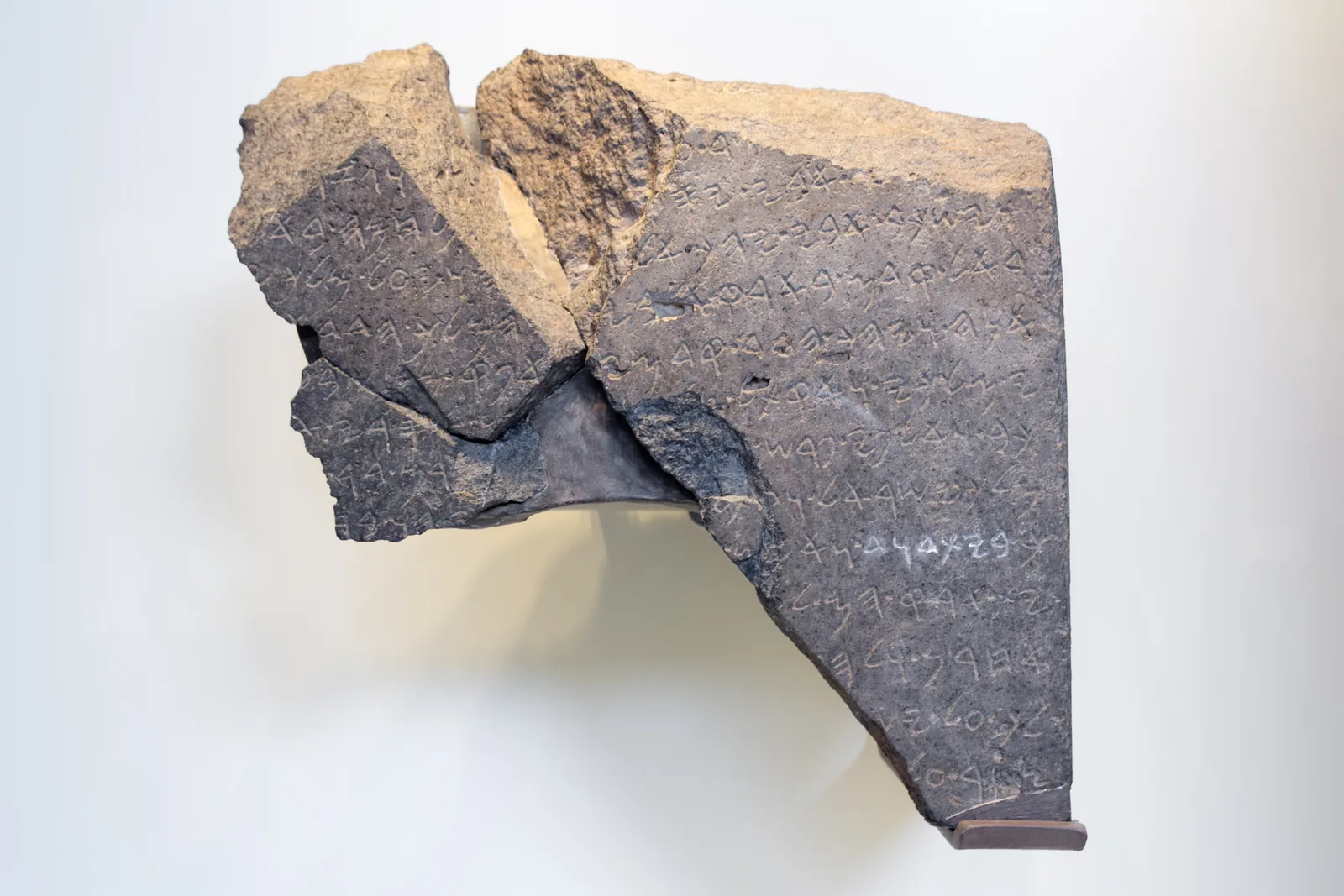
The Tel Dan Stele (original), Israel Museum, Jerusalem. The Aramaic inscription includes the phrase “House of David.”
Photo: Oren Rozen, via Wikimedia Commons, CC BY-SA 4.0.

The story
In July 1993, during Avraham Biran's long excavation at Tel Dan in northern Israel, expedition member Gila Cook noticed a broken basalt slab built into a later wall in the plaza outside the city gate. Two smaller pieces were found nearby in June 1994. All three had been reused as building stone, so the monument was broken up in antiquity. The Israel Museum in Jerusalem holds it today.[S15][S9][S6][S4]
About 13 partial lines of Old Aramaic survive. An Aramaean king, whose name is lost, says that his father died, that the king of Israel had invaded his father's land, and that the god Hadad made him king. Then he boasts of killing kings. Christopher Rollston's translation, which follows Biran and Naveh's arrangement, reads in part: "[I killed Jeho]ram son of [Ahab] King of Israel, and I killed [Ahaz]iahu son of [Jehoram] king of the house of David." Everything in square brackets is restored.[S8][S15]
Line 9 is why the stone is famous. It has the word bytdwd, written without the dot that divides other words. Most scholars read it as "house of David", the name of the dynasty that ruled Judah, much as Assyrian texts called Israel the "House of Omri". Rollston calls this the only compelling translation and adds that it refers to the Davidic dynasty, not to David himself. A minority proposed a place name or a divine title instead.[S8][S15][S9]
Most scholars identify the king as Hazael of Damascus. George Athas examined the fragments in Jerusalem and judged them genuine, but he argued for Hazael's son Bar-Hadad, a date just after 800 BCE, a different arrangement of the fragments, and a place-name reading of bytdwd. Hallvard Hagelia's survey of the debate finds that most scholars still place the fragments side by side, roughly as the first editors did.[S8][S10][S9]
On the usual restoration, the Aramaean king boasts of killing Jehoram of Israel and Ahaziah of Judah. 2 Kings 9 records that Jehu killed them. Rollston suggests that Jehu and Hazael were working together, so that both could claim the deed.[S5][S8][S15]
The stone names the House of David about 150 years after David's reign, as the Bible records that dynasty. Gerald Flurry of the Armstrong Institute calls it the first conclusive archaeological evidence for David as a historical figure. The inscription itself describes the later dynasty; it does not describe the size of David's kingdom, which is recorded in Samuel and Kings.[S13][S9][S15]
Key findings
| Finding | Sources |
|---|---|
An excavated stele, found in 1993 and 1994Fragment A was found in July 1993 in Biran's excavation, built into a later wall outside the city gate at Tel Dan; Fragments B1 and B2 followed in June 1994. The basalt stele with its Aramaic text is held by the Israel Museum (record 371407-0). | S6 S9 S15 S1 S2 S17 S4 S8 S5 S14 S13 |
"House of David" is the majority readingLine 9 reads bytdwd. Most scholars take it as "House of David", the dynasty of Judah; a minority, including Athas and the Copenhagen school, proposed a place name or other readings. On the majority reading it is the earliest known reference to David's house outside the Bible, with a disputed Mesha stele reading the only rival. | S5 S8 S9 S15 S1 S2 S17 S6 |
The author and the kings' names are reconstructionsNo royal name survives. Most scholars attribute the stele to Hazael of Damascus; Athas argues for his son Bar-Hadad. Jehoram and Ahaziah are restored from a few letters, and Hagelia finds a majority, not unanimity, for that reconstruction. | S5 S8 S9 S10 S15 |
The stele boasts of killings that 2 Kings 9 records as Jehu'sOn the usual restoration the Aramaean king boasts of killing Jehoram and Ahaziah. 2 Kings 9 records that Jehu killed them. Rollston suggests Jehu and Hazael acted together, so that both could claim the deed. | S5 S8 S15 S9 |
It names the dynasty the Bible recordsThe stele fits a dynasty known as the House of David in the later 9th century BCE, about 150 years after David's reign, which the Bible records. The inscription itself does not describe the size of his kingdom. The forgery theories of the 1990s found little support. | S8 S9 S15 S13 S10 |
Labels and sources are taken from the linked claims, so they stay in step with the ledger. How we label evidence.
Where scholars land
Conservative
Gerald Flurry (Armstrong Institute of Biblical Archaeology)
Gerald Flurry of the Armstrong Institute of Biblical Archaeology, which helped bring the stele to the United States in 2024, calls it the first conclusive archaeological evidence pointing to King David's existence as a true historical figure. He says it also shows David headed a royal dynasty that a Syrian king still named more than 150 years later.
Critical
George Athas
George Athas examined the fragments in Jerusalem and judged them genuine, but calls Biran and Naveh's arrangement well nigh impossible. He places Fragment B below Fragment A, dates the text just after 800 BCE to Hazael's son Bar-Hadad, and reads bytdwd as a place name, most likely Jerusalem, rather than a dynasty.
Each column states a position in that scholar or institution's own best terms, with a named source.
Records vs. retellings
What people often say
The Tel Dan stele confirms that King David existed.
What the object or text actually says
Line 9 has bytdwd, read by most scholars as "House of David", in an Aramaean king's boast. It names the dynasty the Bible records, about 150 years after David's reign. The stone names the house, not the man; David's own reign is recorded in Scripture.
Where it stands
Most scholars take it as the earliest reference to David's dynasty outside the Bible. The biblical account of David's reign does not depend on the stone naming the man himself.
Claims 4, 10 ↓What people often say
The stele names King Jehoram and King Ahaziah.
What the object or text actually says
Only parts of the names survive. Rollston's translation prints them as [Jeho]ram son of [Ahab] and [Ahaz]iahu son of [Jehoram]; the bracketed letters are restored.
Where it stands
Hagelia reports a majority for this reconstruction. Athas argues the fragments were joined wrongly and that the text has nothing to do with these two kings.
Claims 6, 8 ↓What people often say
The stele and 2 Kings 9 tell the killings in the same way.
What the object or text actually says
On the usual restoration the Aramaean king boasts of having killed the two kings. 2 Kings 9:14-28 records that Jehu killed them.
Where it stands
Rollston and a reference site suggest Jehu and Hazael acted in concert, or that Hazael claimed an ally's work. The biblical account records Jehu as the one who killed them.
Claim 9 ↓What people often say
It shows David ruled a great united kingdom from Dan to Beersheba.
What the object or text actually says
It mentions a king of Israel and a king of bytdwd in the later 9th century BCE. It does not describe the size of David's kingdom, which is recorded in Samuel and Kings.
Where it stands
The stele is silent on the extent of David's kingdom. That silence is about the stone, not about the biblical account.
Claim 11 ↓The object
Tel Dan stele ("House of David" inscription), Fragments A, B1 and B2
- Name
- Tel Dan stele ("House of David" inscription), Fragments A, B1 and B2
- Provenance
- excavated
- Findspot
- Tel Dan, northern Israel: Fragment A built into a later wall in the plaza outside the city gate; Fragments B1 and B2 nearby, also in secondary use
- Found
- 1993 (Fragment A, July); 1994 (Fragments B1 and B2, June)
- Holder
- Israel Museum, Jerusalem (collection of the Israel Antiquities Authority)
- Catalog
- Israel Museum record 371407-0; IAA 1996-125, 1993-3162
- Peer review
- published
- Announced by
- excavator
- Notes
- Basalt. The Jewish Museum and the atiqot.org.il reading of the Israel Museum record give H 34, W 32 cm for the stele as displayed; Hagelia gives Fragment A as 32 cm high and 22 cm wide. The first editions (Biran and Naveh, IEJ 43, 1993, and IEJ 45, 1995) are cited from later reports; the Jewish Museum's object page (S6) and the edition-based translation by Rollston (S8) stand in for them.
- Primary publication
- S1 S2
Bible references
References only. Verse text is not reproduced here.
- 2 Kings 8:7-15 Hazael becomes king of Aram-Damascus after Ben-Hadad
- 2 Kings 8:28-29 Joram of Israel is wounded fighting Hazael at Ramoth-gilead, and Ahaziah of Judah visits him
- 2 Kings 9:14-28 Jehu kills Joram of Israel and Ahaziah of Judah, the deaths the stele appears to claim for the Aramaean king
- 2 Kings 10:32-33 Hazael strikes Israel throughout its territory
- 1 Kings 19:15-17 Elijah is told to anoint Hazael king of Aram and Jehu king of Israel
- 2 Chronicles 22:5-9 The Chronicler's account of Ahaziah's alliance with Joram and his death at Jehu's hands
- 2 Samuel 7:16 The promise that David's house and kingdom will endure, the biblical root of the phrase "house of David"
Timeline
| Date | What happened | Sources |
|---|---|---|
| 750 BCE | By about the mid-8th century BCE the fragments had been reused in later structures, so the stele was broken up soon after it was set up. | S15 S16 |
| 800 BCE | George Athas's alternative: the stele dates to just after 800 BCE and was set up by Hazael's son Bar-Hadad. | S10 S15 |
| 842-800 BCE | Hazael's reign as given by one reference site (c. 842-800 BCE). The Jewish Museum dates his victories over Israel and Judah to c. 842-806 BCE. | S15 S7 |
| 1966 | Avraham Biran's excavation of Tel Dan began; it continued until 1999. | S9 S15 |
| 1993 | Biran and Naveh published Fragment A in the Israel Exploration Journal 43, as later reports record. | S15 |
| 1993-07 | Gila Cook, a member of the expedition, noticed Fragment A built into a wall in the plaza outside the city gate. | S15 S6 S9 |
| 1994 | Garbini argued the inscription was a forgery, and Lemche and Thompson proposed reading bytdwd as a place name (as reported by Hagelia). | S9 |
| 1994-06 | Fragments B1 (June 20) and B2 (June 30) were found at Tel Dan. | S9 S15 |
| 1995 | Biran and Naveh published Fragments B in the Israel Exploration Journal 45, as later reports record. | S8 S15 |
| 1997 | At a symposium recorded in Biblical Archaeology Review, Lemche called the stele a fraud (as reported by Hagelia). | S9 |
| 2001-03-01 | Athas reported on the B-Hebrew list that he had examined the fragments in Jerusalem, found them genuine, and rejected the editors' arrangement. | S10 |
| 2003 | Athas published his monograph on the inscription, arguing for Bar-Hadad, a date near 796 BCE and a toponym reading of bytdwd. | S9 S15 |
| 2009 | Hallvard Hagelia published The Dan Debate, a survey of research on the inscription. | S9 |
| 2024-09-22 | The Armstrong Institute held a celebration for the stele's display at Armstrong Auditorium, Edmond, Oklahoma. | S14 |
| 2024-12-05 | The stele went on view at the Jewish Museum, New York, until January 5, 2025. | S6 S7 |
Competing explanations
bytdwd is "House of David", the dynasty of Judah
- Case for
- Most scholars take it this way (S8, S9). Hagelia reports that scribes varied in their use of word dividers, so the missing divider is no longer seen as a serious problem (S9). A reference site compares it to the Assyrian name "House of Omri" for Israel (S15). The phrase sits beside "king of Israel", which suits a neighbouring kingdom (S9).
- Case against
- The word is written without a divider. Athas and, at first, Lemche and Thompson read it as a place name; others proposed a divine title (S10, S9, S15).
- What would settle it
- Another 9th- or 8th-century inscription using bytdwd, or a further fragment of line 9's context, would narrow this.
- Sources
- S8 S9 S15 S10
bytdwd is a place name (Bayt-Dawid)
- Case for
- Athas reads bytdwd as a place name of the Beth-X type (S10). Hagelia reports that he took Bayt-Dawid as the name of a city or a state, like Bethel or Beth-Rehob, and argued it was most likely Jerusalem around 800 BCE (S9). Lemche and Thompson proposed a holy place (S9).
- Case against
- No place called bytdwd is known elsewhere, and Hagelia judges that the toponym theory has never become the scholarly consensus (S9). Even as a place name, Hagelia notes, it could designate Judah, so the gap between the readings is not vast (S9).
- What would settle it
- An independent attestation of a place named Bayt-Dawid would support it; none is known.
- Sources
- S9 S10
The author was Hazael rather than his son Bar-Hadad
- Case for
- The Jewish Museum, Rollston and Hagelia all report that most scholars credit Hazael, whose wars with Israel and Judah fit a later 9th-century date (S5, S8, S9).
- Case against
- No royal name survives. Athas dates the text just after 800 BCE and credits Bar-Hadad; some scholars name a Benhadad or decline to choose (S10, S9).
- What would settle it
- A fragment preserving the king's or his father's name would settle it.
- Sources
- S5 S8 S9 S10
What would settle it
- A further fragment preserving the king's name, his father's name, or more of lines 7-9 would settle the authorship and the restored royal names.
- A physical study of how Fragments A and B fit, published with new photographs, would narrow the arrangement dispute.
What remains unknown
- The name of the king who set up the stele.
- Whether lines 7-8 name Jehoram and Ahaziah, and so whether the stele's boast concerns the same killings 2 Kings 9 records.
- How Fragments A and B were arranged on the original stele.
- What the House of David was like in the 9th century BCE, which the stele names but does not describe.
All 13 claims, each labelled and sourced
All 13 claims, each labelled and sourced
| Claim | Evidence | Status | Sources | Checked |
|---|---|---|---|---|
| 1.Fragment A was found in July 1993 in Avraham Biran's excavation at Tel Dan, built into a later wall in the plaza outside the city gate. Fragments B1 and B2 were found nearby in June 1994 (Hagelia gives June 20 and June 30). All three were in secondary use, so the stele was broken up in antiquity. Biran and Joseph Naveh published Fragment A in 1993 and Fragments B in 1995. | Confirmed | Broad consensus | S6 S9 S15 S1 S2 S17 | 2026-11-21 |
| 2.The stele is basalt and its inscription is in Old Aramaic, with words separated by dots. The Israel Museum record, as read by a reference site and quoted by the Jewish Museum, dates it to Iron Age II, the 9th century BCE, and gives its size as 34 by 32 cm. It is held by the Israel Museum, Jerusalem (record 371407-0; IAA 1996-125 and 1993-3162). | Confirmed | Broad consensus | S6 S4 S8 S9 S15 | 2026-11-21 |
| 3.In the surviving text an Aramaean king, whose name is lost, says the king of Israel had invaded his father's land and that the god Hadad made him king, then boasts of killing kings. The words "king of Israel" and, in line 9, bytdwd are among the preserved text. | Confirmed | Broad consensus | S5 S8 S9 S15 S1 S2 S17 | 2026-11-21 |
| 4.Line 9's bytdwd means "House of David", the dynasty (or kingdom) of Judah. Rollston writes that "the majority of scholars consider 'house of David' to be the only compelling translation". Hagelia finds the reading almost generally accepted and judges the missing word divider an out-dated objection. Ehud Ben Zvi's 1994 article is listed by Hagelia as hesitantly in favour. Athas reads it as a place name of the Beth-X type. | Confirmed | Majority view | S6 S8 S9 S15 Against: S10 | 2026-11-21 |
| 5.No king's name survives. Most scholars attribute the stele to Hazael of Damascus: the Jewish Museum says scholars believe he is its author, Rollston calls Hazael "the most convincing conclusion", and Hagelia finds most scholars agree. Athas argues for Hazael's son Bar-Hadad and a date just after 800 BCE, and Hagelia notes others who argue for one of the Benhadads or decline to name a king. | n/a | Majority view | S5 S8 S9 S10 S15 Against: S10 | 2026-11-21 |
| 6.How the fragments fit together is debated. Rollston writes that Fragments A and B "do not join together perfectly". Athas calls Biran and Naveh's arrangement "well nigh impossible physically and palaeographically" and places Fragment B below Fragment A. Hagelia concludes that most scholars still place A side by side with B, roughly as the editors did. | n/a | Disputed | S8 S10 S9 | 2026-11-21 |
| 7.The stele is a modern forgery. Hagelia reports that Garbini (1994) and Gmirkin (2002) argued this, and that Lemche called it a fraud at a 1997 symposium; a reference site attributes forgery proposals to the Copenhagen school. Hagelia judges these arguments unpersuasive. The fragments came from a controlled excavation, Athas judged them genuine after examining them, and Hagelia concludes "the inscription is no forgery". | No direct evidence | Broad consensus | S9 S15 S10 | 2026-11-21 |
| 8.The kings' names in lines 7-8 are restorations: [Jeho]ram son of [Ahab], king of Israel, and [Ahaz]iahu son of [Jehoram], of the house of David. Hagelia writes that opinions differ on whether these lines name kings of Israel and Judah, "but there seems to be a majority supporting that reconstruction of the text". Athas holds that the text has nothing to do with Jehoram and Ahaziah. | n/a | Majority view | S8 S9 S10 S15 Against: S10 | 2026-11-21 |
| 9.On the usual restoration the stele has the Aramaean king boast of killing Jehoram of Israel and Ahaziah of Judah. 2 Kings 9:14-28 records that Jehu killed them. Rollston suggests that Jehu and Hazael were working together, so that both could claim the deed. | n/a | Majority view | S5 S8 S15 S9 | 2026-11-21 |
| 10.By the later 9th century BCE a dynasty or kingdom known as the House of David existed and was known to an Aramaean king. Hagelia reports that most contributors read bytdwd as pointing to the Davidic dynasty or to Judah, and Rollston says it "certainly refers to the Davidic dynasty" though not to David the historical figure. Lemche, as Hagelia reports, holds that it says nothing about David's historicity. | Consistent | Majority view | S8 S9 S15 S13 | 2026-11-21 |
| 11.The inscription names a king of Israel and a king of bytdwd about 150 years after David's reign and does not describe the size of his kingdom. David's reign and kingdom are recorded in Samuel and Kings. The stele itself is silent on their extent. | n/a | Broad consensus | S15 S8 S9 Against: S13 | 2026-11-21 |
| 12.The Jewish Museum calls the stele "the earliest known mention of the royal House of David apart from in the Hebrew Bible". Hagelia qualifies this: "With the possible exception of the Mesha stele", it is the oldest extra-biblical reference to David, and a reference site calls André Lemaire's Mesha reading disputed. The claim depends on the majority reading of bytdwd. | n/a | Majority view | S5 S9 S15 | 2026-11-21 |
| 13.The Israel Museum lent the stele, from the collection of the Israel Antiquities Authority, for a 2024 showing at Armstrong Auditorium in Edmond, Oklahoma, and then to the Jewish Museum, New York, where it was on view December 5, 2024 to January 5, 2025. The New York installation was supported by the Armstrong International Cultural Foundation in collaboration with the Armstrong Institute of Biblical Archaeology. | Confirmed | Broad consensus | S6 S5 S14 S13 | 2026-11-21 |
Evidence: what the object, inscription or text supports. A Documented record tag marks a purchase, edition, test, retraction or disclosure. Status: how far specialists agree. How we label evidence.
Sources
- S1Avraham Biran and Joseph Naveh, “An Aramaic Stele Fragment from Tel Dan”, Israel Exploration Journal 43 (1993), pp. 81-98, 1993.excavation reportTier 1neutral Link · accessed 2026-11-23
Cited in Hagelia (S9) - S2Avraham Biran and Joseph Naveh, “The Tel Dan Inscription: A New Fragment”, Israel Exploration Journal 45 (1995), pp. 1-18, 1995.excavation reportTier 1neutral Link · accessed 2026-11-23
Cited in Hagelia (S9) - S4atiqot.org.il (Antiques), “Tel Dan stele (independent antiquities site, atiqot.org.il)”, atiqot.org.il, undated web page; record read by the site on 2026-10-21.secondaryTier 2neutral Link · accessed 2026-11-21
Note: Not the IAA journal 'Atiqot. Quotes the Israel Museum record: basalt, 34 x 32 cm, Iron Age II, 9th century BCE, findspot Dan, IAA 1996-125 and 1993-3162. Explicitly does not offer a reading of the inscription. - S5The Jewish Museum, New York, “The Tel Dan Stele With House of David Inscription (collection section text, PDF)”, The Jewish Museum, New York, file created 2024-11-19.museum recordTier 2neutral Link · accessed 2026-11-21
Note: Gallery text. Text extracted locally from the PDF; quotes were matched against the extracted text. Some ligature-bearing words did not extract, so only intact sentences are quoted. - S6The Jewish Museum, New York, “Tel Dan Stele (exhibition page, Dec. 5, 2024 - Jan. 5, 2025)”, The Jewish Museum, New York, 2024.museum recordTier 1neutral Link · accessed 2026-11-21
Note: Gives the object credit line (Dan; Iron Age II, 9th century BCE; basalt; H 34, W 32 cm; Collection the Israel Antiquities Authority, 1996-125, 1993-3162) and the loan from the Israel Museum. Opened with The page; a request received an access error. - S7The Jewish Museum, New York, “Tel Dan Stele on Display at the Jewish Museum (press release)”, The Jewish Museum, New York, 2024-10-21.institutionalTier 2neutral Link · accessed 2026-11-21
Note: Opened with The page; a request received an access error. Says the inscription "lends archaeological evidence to the existence of the Biblical King David as a historical figure" (The page reading only; not matched against the page source). - S8Christopher Rollston, “The Tel Dan Inscription”, Bible Odyssey (Society of Biblical Literature), 2014-12-08.institutionalTier 2critical Link · accessed 2026-11-21
Note: Includes the author's translation of lines 1-13 based on Naveh and Biran's arrangement. Gives 1995 for the excavation of Fragment B, where S9, S15 and S6 give 1994. - S9Hallvard Hagelia, “The Dan Debate: The Tel Dan Inscription in Recent Research (Recent Research in Biblical Studies 4)”, Sheffield Phoenix Press (PDF hosted by the Society of Biblical Literature), 2009.academic bookTier 2neutral Link · accessed 2026-11-21
Note: Full book PDF; text extracted locally. Used for the find details, the forgery chapter, the fragments chapter, the originator chapter, the bytdwd chapter and the historiographical summary. Hagelia states his own position as opposing the minimalists. - S10George Athas, “Re: Tel Dan (Reprise)”, B-Hebrew mailing list archive (lists.ibiblio.org), 2001-03-01.secondaryTier 3critical Link · accessed 2026-11-21
Note: A list post by Athas himself, written before his 2003 monograph. Used only for his own stated positions. - S13Gerald Flurry, “King David Comes to America”, Armstrong Institute of Biblical Archaeology (Let the Stones Speak, July-August 2024), 2024-07.advocacyTier 3conservative Link · accessed 2026-11-21
Note: Written before the 2024 loan; it says the display details were still being finalized. - S14Armstrong Institute Staff, “A Celebration of the 'House of David'”, Armstrong Institute of Biblical Archaeology, 2024-09-27.advocacyTier 3conservative Link · accessed 2026-11-21
- S15Editors of biblical-archaeology.org, “Tel Dan inscription”, biblical-archaeology.org (Interactive Archaeological Map), undated web page.secondaryTier 3neutral Link · accessed 2026-11-21
Note: Reference site with no named author. Never the sole source for a Confirmed row. - S16Center for Online Judaic Studies (entry signed David Danzig), “Tel Dan Stele, c. 840 BCE”, Center for Online Judaic Studies (COJS), undated web page.institutionalTier 2neutral Link · accessed 2026-11-21
Note: Says the fragments were reused in mid-8th-century buildings and that Fragment A was found during restoration of the gateway. It gives the current location as the Skirball Museum, Jerusalem, which conflicts with S5, S6, S8 and S15 (Israel Museum); not used for location. - S17Biblical Archaeology Society, “The Tel Dan Inscription: The First Historical Evidence of King David from the Bible”, Bible History Daily / Biblical Archaeology Society, undated web page.secondaryTier 2neutral Link · accessed 2026-11-23
Note: Opened 23 November 2026. Names Biran's 1993 excavation and Naveh's first reading.
Tier 1 is a primary record: a museum record, excavation report, edition or peer-reviewed paper. Tier 3 sources are cited as the views of those organizations. How we label evidence.
Evidence log
- Fragment A found in Biran's excavation and published by Biran and Naveh (as reported in S15).
- Fragments B1 and B2 found (S9). Garbini's forgery article and Lemche and Thompson's place-name reading followed (S9).
- Biran and Naveh published Fragments B and their join with A (as reported in S8).
- Athas reported that the fragments are genuine but the editors' arrangement is not, and that the author was Bar-Hadad (S10).
- Athas's monograph argued for a toponym reading of bytdwd, likely Jerusalem (S9, S15).
- Hagelia's survey judged the inscription genuine and found majorities for Hazael, for the restored kings' names and for the House of David reading (S9).
- The Jewish Museum's gallery text noted the stele is not consistent with 2 Kings 9 on who killed the kings (S5, S6).
- Entry first written.
- Scripture policy: dropped the Lemche column that disputed David's historicity; reframed the 2 Kings 9 boast so the biblical account is not treated as contradicted; reworded dek, verdict and findings.
- update Sources list tightened: each claim now cites only sources we opened and checked, and a few sentences we couldn't check were removed.
Read next
The Pilate stone (Caesarea, 1961)
Another excavated, museum-held inscription that names a figure the Bible records.
Hezekiah's tunnel and the Siloam inscription (Jerusalem, found 1880)
Another Iron Age inscription from the kingdoms of Israel and Judah, with its own dating debate.
The Cyrus Cylinder (Babylon, found 1879)
Another inscription that fits a biblical account, while the stone itself is silent on some of the details Scripture records.