Objects and inscriptions
The Cyrus Cylinder (Babylon, found 1879)
A clay cylinder from Babylon records Cyrus returning gods and peoples to their homes. That policy fits the decree in Ezra 1 and 2 Chronicles 36. The cylinder itself never mentions Jews, Judah or Jerusalem.
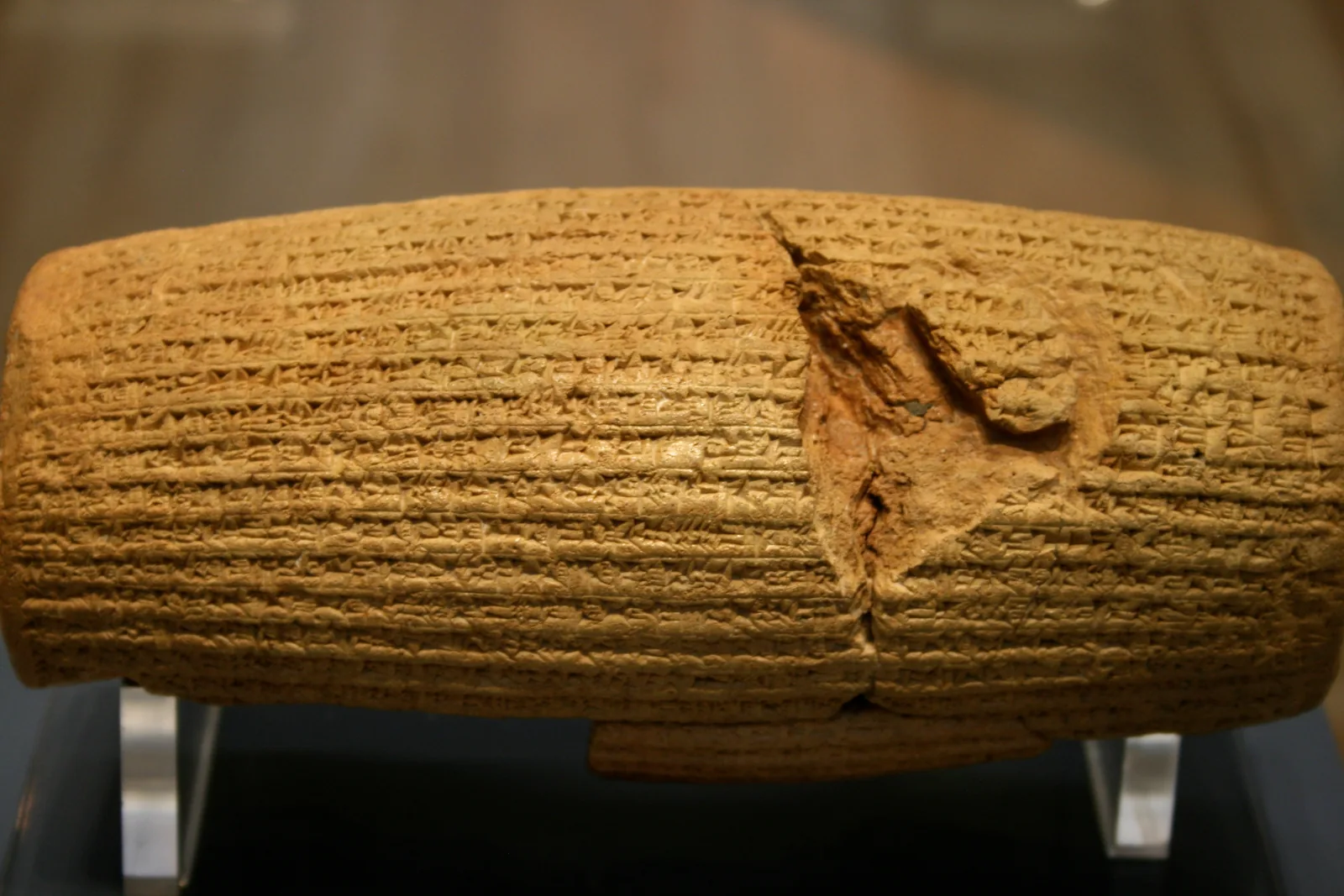
The Cyrus Cylinder (original), British Museum, London. The cylinder records Cyrus’s policy in Babylon after 539 BC. It does not mention Judah or the Jerusalem temple. Ezra 1 records the decree that allowed the exiles to return and rebuild the house of the Lord.
Photograph by Mike Peel (www.mikepeel.net), CC BY-SA 4.0, via Wikimedia Commons.

The story
In 1879 the explorer Hormuzd Rassam found, at the site of ancient Babylon, a small barrel-shaped clay cylinder covered in cuneiform. The museum still holds it; the Livius reference site gives its number as BM 90920. A small fragment holding lines 36–45, which joins the main part, was once in Yale University's collection and is now with it in the British Museum.[S12][S7][S9]
The text is in Akkadian, the language of Babylon, and it speaks in the voice of the conqueror. It describes Nabonidus, the last Babylonian king, as a ruler who angered Marduk. Marduk then "took the hand of Cyrus, king of the city of Anshan" and let him enter Babylon "without fighting or battle," in Irving Finkel's translation. From line 20 Cyrus speaks: "I am Cyrus, king of the universe, the great king."[S2][S8][S7]
The lines that made the cylinder famous come near the end of the main fragment. Cyrus lists Ashur, Susa, Akkad, Eshnunna, Zamban, Meturnu and Der, as far as the land of Guti, "the sanctuaries across the river Tigris." He says he sent their gods back, "collected together all of their people and returned them to their settlements," and returned the gods that Nabonidus had brought into Babylon. Every place named is in Mesopotamia or western Iran. Jews, Judah and Jerusalem do not appear.[S2][S8][S7][S9]
The Bible tells its own Cyrus story. Ezra 1:1–4 and 2 Chronicles 36:22–23 quote a proclamation in which Cyrus says the God of heaven charged him to build a house in Jerusalem, and Ezra 6:3–5 gives an Aramaic order to rebuild the temple and return its gold and silver vessels. Isaiah 44:28 and 45:1 name Cyrus as the Lord's shepherd and anointed.[S14][S15][S16][S17][S18]
Readers have often joined the two. Stand to Reason and the Armstrong Institute treat the cylinder as outside support for the biblical decree. The Biblical Archaeology Society notes the close parallels with Ezra 1:1–4. Amélie Kuhrt reads the cylinder as a Babylonian document in Babylonian conventions, and its language of restoration as stock rhetoric used by foreign conquerors. The decree for the Jerusalem temple is recorded in Ezra and 2 Chronicles; the cylinder itself does not name Judah.[S11][S6][S9][S10]
In the twentieth century the cylinder took on a new life. A British Museum curator traces its fame as the "First Charter of Human Rights" to the late 1950s and the Shah of Iran's promotion of Cyrus. Livius notes a fake translation, still online, that swaps Marduk for Ahuramazda and adds lines on freedom of religion. The cylinder itself is a king's building and restoration text, and it does not contain such a charter.[S10][S7][S13]
Key findings
| Finding | Sources |
|---|---|
A real inscription of Cyrus from BabylonA clay cylinder found at Babylon in 1879 and held by the British Museum carries an Akkadian text in Cyrus's name, written after he took Babylon in 539 BCE. | S2 S7 S9 S12 S1 S8 S13 |
It records gods and peoples sent homeIn lines 30–34 Cyrus says he returned the gods of a list of cities east of the Tigris to their sanctuaries, gathered their people and returned them to their settlements, and sent the gods Nabonidus had brought into Babylon back to their shrines. | S2 S8 |
It never mentions Jews, Judah or JerusalemEvery place it names is in Mesopotamia or western Iran. The cylinder does not name Judah or Jerusalem; Cyrus's decree for the temple is recorded in Ezra 1:1–4 and 2 Chronicles 36:22–23. | S2 S8 S9 S7 S6 S11 |
Read by many scholars as Babylonian royal rhetoricKuhrt and the Livius reference site read the text as a conventional Babylonian royal inscription. Kuhrt argues it does not show a new Persian policy of toleration. | S10 S7 S13 |
"First charter of human rights" is a modern labelThe label grew from the late 1950s, partly through the Shah's promotion of Cyrus. No line of the cylinder sets out human rights, and a widely shared 'human rights' translation is a fake. | S10 S7 S13 S2 |
Labels and sources are taken from the linked claims, so they stay in step with the ledger. How we label evidence.
Where scholars land
Conservative
Armstrong Institute of Biblical Archaeology (Heather Lexa)
The Armstrong Institute of Biblical Archaeology, through Heather Lexa, calls the cylinder's account of restored sanctuaries and returned peoples an astounding parallel to the Cyrus decree of 2 Chronicles and Ezra. On this reading the artifact, though addressed to Babylon's own people, serves to substantiate that a decree just like the Bible's was issued.
Critical
Biblical Archaeology Society (Nathan Steinmeyer, 2026)
The Biblical Archaeology Society, in Nathan Steinmeyer's 2026 article, notes remarkable similarities between the cylinder and Ezra 1:1–4 but stresses that it never speaks of Jerusalem or the Judeans. It cannot be directly connected to the biblical story, yet both may reflect the same kind of official Persian proclamation, which he judges certainly possible, if not probable.
Skeptical
Amélie Kuhrt (University College London)
Amélie Kuhrt argues that the cylinder is a Babylonian document that fits Babylonian conventions and reflects a negotiated accommodation between a Persian conqueror and the conquered. It does not show a new policy of toleration, and its talk of restoration is familiar local rhetoric used by foreign victors and would-be kings.
Each column states a position in that scholar or institution's own best terms, with a named source.
Records vs. retellings
What people often say
The Cyrus Cylinder mentions the Jews and their return to Jerusalem.
What the object or text actually says
The cylinder names Ashur, Susa, Akkad, Eshnunna, Zamban, Meturnu, Der and the land of Guti, and the gods of Sumer and Akkad. It does not mention Jews, Judah or Jerusalem.
Where it stands
The Biblical Archaeology Society and Livius both note the absence. The Jerusalem decree comes from Ezra and 2 Chronicles, not from the cylinder.
Claims 4, 7 ↓What people often say
Archaeology confirms Cyrus's decree in Ezra.
What the object or text actually says
The cylinder records a policy of returning gods and peoples in Mesopotamia. It does not quote or mention the Ezra decree.
Where it stands
Consistent with the Bible's picture of Cyrus, not a confirmation of the decree. Conservative writers read it as supporting the existence of such a decree; BAS says it cannot be directly connected to the biblical story.
Claims 6–7 ↓What people often say
The cylinder is the world's first charter of human rights.
What the object or text actually says
It is a royal text praising Cyrus as Marduk's chosen king and recording restorations of gods, peoples and Babylon's walls.
Where it stands
A modern label, traced by John Curtis to the late 1950s and the Shah's promotion of Cyrus. A fake 'human rights' translation that replaces Marduk with Ahuramazda still circulates.
Claim 9 ↓What people often say
Cyrus introduced a new, tolerant religious policy.
What the object or text actually says
The cylinder's restoration language follows Babylonian royal conventions.
Where it stands
Kuhrt and Livius say it shows no new policy of toleration. Whether the Achaemenids had a 'religious policy' at all is a further question Kuhrt has raised.
Claims 8, 10 ↓The object
Cyrus Cylinder (Akkadian clay cylinder of Cyrus, king of Persia)
- Name
- Cyrus Cylinder (Akkadian clay cylinder of Cyrus, king of Persia)
- Provenance
- excavated
- Findspot
- Babylon (found by Hormuzd Rassam); exact spot not confirmed from an opened source
- Found
- 1879
- Holder
- British Museum, London
- Catalog
- BM 90920 (per Livius); registration 1880,0617.1941 from the British Museum collection URL, page cited from its URL and later reports
- Peer review
- published
- Announced by
- excavator
- Notes
- Livius: fragment A is about 23 cm long and 8 cm across, inscribed with lines 1–35; fragment B (8.6 × 5.6 cm, lines 36–45) was once at Yale as NBC 2504 and is now with fragment A in the British Museum. Livius's transcript follows Hanspeter Schaudig's edition; its translation is based on Mordechai Cogan's in The Context of Scripture II (2003). Neither print edition was consulted for this entry.
- Primary publication
- S2 S8
Bible references
References only. Verse text is not reproduced here.
- Ezra 1:1-4 Quotes Cyrus's proclamation charging him to build a house in Jerusalem
- Ezra 6:3-5 The Aramaic record of Cyrus's order to rebuild the temple and return its vessels
- 2 Chronicles 36:22-23 Ends the Chronicler's history with the same Cyrus proclamation
- Isaiah 44:28 Calls Cyrus the Lord's shepherd who will say Jerusalem shall be rebuilt
- Isaiah 45:1 Names Cyrus as the Lord's anointed
- Isaiah 45:13 Says Cyrus will rebuild the Lord's city and let the exiles go
Timeline
| Date | What happened | Sources |
|---|---|---|
| 1879 | Hormuzd Rassam finds the cylinder at Babylon; it goes to the British Museum. | S12 S7 S9 |
| 1950s | According to John Curtis, the cylinder begins to be described as the First Charter of Human Rights from the late 1950s, partly through the Shah of Iran's promotion of Cyrus. | S10 |
| 1971 | The cylinder is used in Iran's celebration of 2,500 years of Persian monarchy; Livius says a copy given to the UN had its religious references removed. | S7 S10 |
| 2008-07-16 | History News Network reposts a Telegraph report that German historians call the cylinder propaganda. | S13 |
| 2026-09-13 | The Biblical Archaeology Society publishes Nathan Steinmeyer's article on the cylinder and Ezra. | S9 |
| -539 | Cyrus takes Babylon (October 539 BCE per Livius). The cylinder's text is written in his name after the conquest. | S7 S2 S13 |
Competing explanations
The cylinder supports the existence of the Ezra decree
- Case for
- The cylinder shows Cyrus returning gods and peoples to their homes, the same kind of act Ezra describes (S2). Armstrong Institute calls this an astounding parallel that serves to substantiate the existence of such a decree (S6); Stand to Reason treats it as outside evidence for the return of the Jews (S11).
- Case against
- The cylinder names only Mesopotamian places and never mentions Jews, Judah or Jerusalem (S2, S8, S9). Kuhrt reads its restoration language as standard Babylonian rhetoric, not a new policy (S10).
- What would settle it
- An Achaemenid document that names Judah, Jerusalem or its temple would add outside confirmation of the decree Ezra records.
- Sources
- S6 S11 S2 S9 S10
The cylinder and Ezra reflect the same kind of Persian proclamation, without a direct link
- Case for
- BAS notes the close parallels with Ezra 1:1–4, including a god stirring Cyrus to act, and judges it certainly possible, if not probable, that both reflect official state proclamations (S9).
- Case against
- Kuhrt argues the cylinder reflects a local deal between conqueror and Babylon rather than an empire-wide policy (S10).
- What would settle it
- More Persian-period administrative texts on temples and deportees outside Babylonia would show how general the practice was.
- Sources
- S9 S10
What would settle it
- Reading a complete scholarly edition of the cylinder text would firm up the line numbers and the wording of the restoration passage.
What remains unknown
- Whether the policy in lines 30–34 applied beyond the Mesopotamian cities the cylinder names.
- The exact spot at Babylon where the cylinder was found.
- The wording of the damaged lines 36–45 of fragment B.
All 10 claims, each labelled and sourced
All 10 claims, each labelled and sourced
| Claim | Evidence | Status | Sources | Checked |
|---|---|---|---|---|
| 1.The Cyrus Cylinder is a clay cylinder found at Babylon in 1879 by Hormuzd Rassam and held by the British Museum (museum number 90920, registration 1880,0617.1941). | Confirmed | Broad consensus | S2 S7 S9 S12 S1 | 2026-11-21 |
| 2.The cylinder carries an Akkadian cuneiform text in Cyrus's name, written after his capture of Babylon in 539 BCE. In Finkel's translation, line 20 reads "I am Cyrus, king of the universe, the great king," and line 17 says Marduk had him enter Babylon "without fighting or battle." | Confirmed | Broad consensus | S2 S8 S7 S13 | 2026-11-21 |
| 3.In lines 30–34 Cyrus says he sent back the gods of cities east of the Tigris to their sanctuaries, "collected together all of their people and returned them to their settlements" (Finkel; Livius-Cogan: "I gathered all their inhabitants and returned to them their dwellings"), and returned to their shrines the gods of Sumer and Akkad that Nabonidus had brought into Babylon. | Confirmed | Broad consensus | S2 S8 | 2026-11-21 |
| 4.The places the cylinder names (Babylon, Ashur, Susa, Akkad, Eshnunna, Zamban, Meturnu, Der, the land of Guti, Sumer and Akkad) are in Mesopotamia or western Iran. The text never mentions Jews, Judah or Jerusalem. | Confirmed | Broad consensus | S2 S8 S9 S7 | 2026-11-21 |
| 5.The Bible describes a Cyrus decree for the Jerusalem temple: Ezra 1:1–4 (repeated in 2 Chronicles 36:22–23) quotes a proclamation charging Cyrus to build a house in Jerusalem, and Ezra 6:3–5 gives an Aramaic order to rebuild the temple and return its vessels. This row reports what Scripture records; no copy of the decree has been found outside the Bible. | Confirmed | Broad consensus | S14 S15 S16 S9 | 2026-11-21 |
| 6.The cylinder's picture of a king returning gods and peoples to their homes is consistent with the Bible's account of Cyrus letting the Judeans return and rebuild their temple. BAS judges it certainly possible, if not probable, that both reflect the same kind of official Persian proclamation; Armstrong Institute and Stand to Reason read the cylinder as support for the biblical decree. | Consistent | Majority view | S9 S6 S11 S2 Against: S10 | 2026-11-21 |
| 7.The cylinder does not name Jews, Judah, Jerusalem or the Jerusalem temple, and it does not quote the Ezra decree. The decree itself is recorded in Ezra 1:1–4 and 2 Chronicles 36:22–23. The biblical account does not depend on the cylinder naming Judah. | n/a | Broad consensus | S9 S7 S6 S2 | 2026-11-21 |
| 8.Many scholars read the cylinder as royal propaganda in the Babylonian tradition. Kuhrt calls it a Babylonian document that "fits perfectly with Babylonian conventions" and says its references to restoration are familiar local rhetoric of foreign victors; Livius says Cyrus presented himself as "the perfect ruler" using common Babylonian and Assyrian royal themes; a 2008 Telegraph report says German historians called it "propaganda." | n/a | Majority view | S10 S7 S13 Against: S6 S11 | 2026-11-21 |
| 9.The cylinder is not a "first charter of human rights": no line of it sets out such rights. John Curtis of the British Museum traces that label to the late 1950s and the Shah of Iran's promotion of Cyrus; Livius says the interpretation "ignores the stereotypical nature of the document" and that a fake 'human rights' translation, replacing Marduk with Ahuramazda, circulates online. | No direct evidence | Majority view | S10 S7 S13 S2 | 2026-11-21 |
| 10.Whether the Achaemenid kings had a 'religious policy' at all is questioned. Kuhrt's symposium abstract says the cylinder does not show a new policy of toleration, and Livius says there is no evidence that Cyrus inaugurated one. | n/a | Disputed | S10 S7 Against: S6 | 2026-11-21 |
Evidence: what the object, inscription or text supports. A Documented record tag marks a purchase, edition, test, retraction or disclosure. Status: how far specialists agree. How we label evidence.
Sources
- S1The British Museum, “Collection object W_1880-0617-1941 (Cyrus Cylinder)”, The British Museum, undated web page.museum recordTier 1neutral Link · Archive · accessed 2026-11-23
Note: Opened the British Museum collection record via the Internet Archive snapshot of 17 March 2025 (https://web.archive.org/web/20250317002529/https://www.britishmuseum.org/collection/object/W_1880-0617-1941). The live collection URL is the same. The record identifies the object as the Cyrus Cylinder, museum number 90920, registration 1880,0617.1941, a fired-clay cylinder, produced after 539 BC in Babylon, excavated by Hormuzd Rassam at Amran (Babylon). The museum description is a Babylonian account of Cyrus's capture of Babylon in 539 BC, of the restoration of statues to temples, and of work at Babylon. - S2Irving Finkel (translator), British Museum, “Translation of the Text on the Cyrus Cylinder (FEZANA lesson 2)”, FEZANA (Federation of Zoroastrian Associations of North America), reproducing the British Museum translation, PDF created 2024-01-27.edition/translationTier 1neutral Link · accessed 2026-11-21
Via: Third-party reproduction. The PDF credits "Irving Finkel, Assistant Keeper, Department of the Middle East, British Museum" and cites a British Museum translation URL (britishmuseum.org/explore/highlights/articles/c/cyrus_cylinder_-_translation.aspx) that returned an access error.
Note: Text extracted locally from the PDF (45 numbered lines). A few lines lost characters in extraction; quotes used here come from lines that extracted cleanly. - S6Heather Lexa, “The Cyrus Cylinder: Substantiating an Almost Unbelievable Biblical Decree”, Armstrong Institute of Biblical Archaeology (ArmstrongInstitute.org), October 23 (year not shown on the page).advocacyTier 3conservative Link · accessed 2026-11-21
Note: Calls the cylinder's content "an astounding parallel" and says it "serves to substantiate the existence of just such a decree"; notes it is "directed specifically to the population of Babylon." - S7Livius.org (author not named on the page), “Cyrus Cylinder”, Livius.org, created 1998; last modified 2020-10-12.secondaryTier 3neutral Link · accessed 2026-11-21
- S8Mordechai Cogan (translation), adapted to Hanspeter Schaudig's edition with Bert van der Spek, “Cyrus Cylinder Translation”, Livius.org, created 1998; last modified 2020-07-13.edition/translationTier 2neutral Link · accessed 2026-11-21
Note: Based on Cogan's translation in Hallo and Younger (eds.), The Context of Scripture II (2003). A different translator from S2, so used as the independent reading for R3. - S9Nathan Steinmeyer, “The Cyrus Cylinder”, Biblical Archaeology Society, Bible History Daily, 2026-09-13.secondaryTier 2critical Link · accessed 2026-11-21
- S10Amélie Kuhrt; John Curtis; et al. (symposium abstracts), “Abstracts, The Legacy of Cyrus the Great: Iran and Beyond (symposium)”, Freer|Sackler, Smithsonian (archive.asia.si.edu), undated web page.institutionalTier 2skeptical Link · accessed 2026-11-21
Note: Used for Kuhrt's abstract "The Cyrus Cylinder and its Babylonian Setting" and John Curtis's abstract "The Cyrus Cylinder: Discovery and Creation of an Icon". The symposium date is not shown on the page. - S11Amy K. Hall, “The Cyrus Cylinder”, Stand to Reason, 2013-07-18.advocacyTier 3conservative Link · accessed 2026-11-21
- S12Wayne Jackson, “The Cyrus Decree”, Christian Courier, undated web page.advocacyTier 3conservative Link · accessed 2026-11-21
Note: Source for Rassam as finder; says the cylinder "describes the benevolent policy of Cyrus in restoring captives to their homelands." - S13History News Network (reposting The Telegraph, UK), “Cyrus: Dictator or author of the first bill of rights?”, History News Network, 2008-07-16.secondaryTier 3neutral Link · accessed 2026-11-21
Note: Short excerpt only; the German historians are not named in the text read. - S14Ezra (tr. JPS Tanakh, gender-sensitive edition), “Ezra 1:1-4”, Sefaria, c. 5th-4th century BCE; modern translation.ancient textTier 1neutral Link · accessed 2026-11-21
Note: Text read through the Sefaria API (api/texts/Ezra.1.1-4); the page URL also returned 200. The date given is a broad conventional range, not from an opened source. - S15Ezra (tr. JPS Tanakh, gender-sensitive edition), “Ezra 6:3-5”, Sefaria, modern translation.ancient textTier 1neutral Link · accessed 2026-11-21
- S162 Chronicles (tr. JPS Tanakh, gender-sensitive edition), “2 Chronicles 36:22-23”, Sefaria, modern translation.ancient textTier 1neutral Link · accessed 2026-11-21
- S17Isaiah (tr. JPS Tanakh, gender-sensitive edition), “Isaiah 44:28”, Sefaria, modern translation.ancient textTier 1neutral Link · accessed 2026-11-21
- S18Isaiah (tr. JPS Tanakh, gender-sensitive edition), “Isaiah 45:1-13”, Sefaria, modern translation.ancient textTier 1neutral Link · accessed 2026-11-21
Tier 1 is a primary record: a museum record, excavation report, edition or peer-reviewed paper. Tier 3 sources are cited as the views of those organizations. How we label evidence.
Evidence log
- Cylinder found at Babylon by Hormuzd Rassam and taken to the British Museum (S12, S7).
- Described as the First Charter of Human Rights from the late 1950s, per John Curtis (S10).
- Kuhrt's work on the cylinder and Achaemenid imperial policy is used here from her later symposium abstract (S10).
- The question whether a Persian 'religious policy' existed is used here from Kuhrt's symposium abstract (S10) and Livius (S7).
- BAS article argues the cylinder cannot be directly connected to the biblical narrative (S9).
- Entry first written.
- Scripture policy: rewrote dek, verdict and the confirms-ezra-decree row so the biblical decree is treated as true; the cylinder's silence on Judah is stated without calling the decree into question.
- update Sources list tightened: each claim now cites only sources we opened and checked, and a few sentences we couldn't check were removed.
Read next
The Pilate stone (Caesarea, 1961)
Another inscription that names a biblical figure and fits the office or policy Scripture records, while remaining silent on some details.
The Tel Dan stele ("House of David", 1993-1994)
Another inscription often over-read as naming every detail of a biblical account; both stones are silent on some of what Scripture records.
The Great Isaiah Scroll (1QIsaᵃ) and the Dead Sea Scrolls
The Great Isaiah Scroll is the oldest manuscript of the Isaiah passages that name Cyrus.